Showing posts with label K-Fai Steele. Show all posts

Thursday, March 19, 2020

It Is Normal to Not Be Productive During a Global Crisis

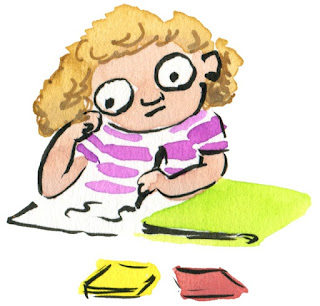
Drawing by a student at Clear Creek Elementary (Charlotte, NC) that
captures exactly how I've been feeling these past few days
I’m writing this blog post from San Francisco, on day 4 of “shelter in place” which means most everything (schools, all workplaces, stores, gyms, bars, the library) is closed and everyone has to stay inside.

Last week at this point everything was changing at an alarming pace. It was unclear if schools would close, I was wondering if I could still responsibly go to a pilates class (I didn’t because I was anxious and lazy), and after every store had run out of toilet paper I unpacked my travel bidet from my camping gear. On top of this I was fretting about the democratic primary results and trying to meet a deadline for a book I’m working on. Then I got the message that the entire city was essentially closing down for an indeterminate amount of time.

I feel afraid, out of control, and bored, which are feelings that are really interesting and challenging to have at the same time. I’m also feeling unproductive. A lot of people in the kidlit community are rolling up their sleeves and doing livestreamed storytimes. So this is great if it's within your comfort zone to record yourself live (I’m going to do some too) and we also need more in other languages like Spanish and Cantonese, and for deaf kids, as Alia Jones wrote on Twitter in conversation with Sujei Lugo and Ann Clare Le Zotte. Even still, the response from the kidlit community re: what can we do? has felt anxious and frantic, which makes sense, because that's the state of our communities now. I’ve even read some particularly tedious and annoying posts over the past couple of days where people humble brag about how much more productive they’re being (they’re even exercising!). Sure, I get it, being an illustrator means you’re already socially isolated, but when we look up from our drafting tables now, everything has changed. We’re making content, but are we just scribbling while Rome burns?


My husband who’s a PhD student has been receiving health alerts from his university. He pointed out a very small part at the bottom of one he received a few days ago (italics are mine):
Finally, for all community members, we realize that there are significant implications of these restrictions for your academic and research progress. Please know that it is entirely reasonable that progress would slow during times of unprecedented global crisis such as this.
In other words, Stanford was telling its students that it’s completely natural and normal to not be as productive as usual during a pandemic. This message isn’t just for PhDs; it resonated with me because as an author-illustrator I’m a freelancer and I’m expected to be productive in a way that’s publicly shareable. So I was given permission to not feel bad about my lack of productivity. For some of you this may be obvious; for me it wasn’t. We’re at the start of a global pandemic and might be quarantined to our homes for months. It’s noble to put out a livestream. But it’s ok to not.

It also reminded me to not equate my self-worth with my productive output, which is a really hard thing to do in our culture and economic system. As a freelancer the only person setting limits on what I get done in a day is me. It’s easy to feel like I’m wasting precious time if I’m not constantly hustling, whether that be getting book deals, doing book promotion, impromptu teaching gigs, or flying for an entire day to give a 45-minute talk. I could fall asleep on my bed every night surrounded by book dummies and picture books and still feel like I wasn’t getting enough done. There’s little continuity to this job, and it’s often isolating and competitive.

It’s tempting to beat yourself up over some made-up metric of productivity. We don't tend to work a typical 9-5 in an office, so it's hard to know what a typical work day looks like, and it's different for everyone. In a recorded lecture that's part of the James Marshall papers at UCONN Marshall says, "My friend Arnold Lobel gets up at 9:00 am every morning and works from 9-5, and has done this for 20 years. His wife Anita Lobel (his ex-wife) refers to him as that little shopkeeper. I thought oh Arnold’s done such beautiful work, I will try this approach myself. And I thought I was going to have a stroke, nothing would happen. I work, work and nothing would happen." You have to figure out a schedule that works for you. But I do think there's a touch of imposter syndrome that occurs when you think that your method of doing it is unconventional, or not adhering to the myth of hard work being long, agonizing hours.

Marshall continued, "I work in basically creative periods of about 3 weeks that’s all I can stand…This is dangerous because when I tell librarians how short it takes me to do a book, I can see in their eyes my stock going down. You have to tell them you worked five years on this book and you’ve drawn with the blood of your slaughtered children and then it’s a masterpiece."

We live in a culture and economy where it's reasonable for freelancers to work 24/7. The consequence is that it can feel like every second that goes by is a second that is potentially wasted. Is that day off from working or from engaging in social media the day that will cost you that dream book deal? I, for one, would like to get off this ride.

In January I was lucky to do a week-long school visit at the American International School in Chennai, India, and I met with high school juniors and seniors to talk about my career path as an artist and a writer. I didn’t mince words; I basically said if you’re not independently wealthy or you don’t connect yourself financially to someone who is, you should be prepared to get a day job. And know that you’ll end up working on projects that you’re not totally passionate about to make ends meet. I gave them ✨practical advice✨. One student asked: do you feel bad when you work on a project you’re not passionate about? Why would that be worth your time at all? I’m sure I pulled myself together and backpedaled, but their question stuck with me. Of course I want to be passionate about everything I make. I don’t want to be scared by the possibility of jobs drying up. I don’t want to become cynical. I want to remind myself that my job is fun (because it is). But I don’t want to have to prove and perform my worth all the time in a public way.

As I enter a second week of who knows how many more weeks of shelter-in-place I’d like to be kinder to myself and be less of an awful boss to myself. I want to open up more space for silliness and humor, and I want to be able to say that I’m scared. I want to be okay with letting my progress slow a bit. Everything in publishing seems to be slowing down too, do you really think anyone’s working? And finally, it’s fine if you don’t do that livestream.

--------------

K-Fai Steele (she/her) is an author-illustrator who grew up in a house built in the 1700s with a printing press her father bought from a magician. She wrote and illustrated A Normal Pig, and illustrated Noodlephant by Jacob Kramer, a Kirkus Best of 2019 picture book. She also illustrated the forthcoming Probably a Unicorn by Jory John. K-Fai was a Brown Handler Writer in Residence at the San Francisco Public Library, a James Marshall Fellow at the University of Connecticut, and an Ezra Jack Keats/Kerlan Memorial Fellow at the University of Minnesota. She lives in San Francisco. Follow her on instagram @areyouokfai.

Monday, January 21, 2019

Artist in the Archives: How (and Why) You Should Be Learning With University Children’s Literature Research Collections

Dummy for In My Garden created by Roger Duvoisin (written by Charlotte Zolotow)
With a collection of over 100,000 children's books and original manuscripts, artwork, galleys, color proofs, and other preliminary materials from 1,700 authors and illustrators, the Kerlan Collection at the University of Minnesota in Minneapolis is, according to its website, “one of the world's great children's literature archives.” I spent three weeks there this past summer as the Ezra Jack Keats/Kerlan Memorial Collection Fellow digging through boxes of sketchbooks and drawings from some of my favorite kidlit creators; James Marshall, Arnold Lobel, Alice and Martin Provensen, Aliki, Edward Ardizzone, Betsy Lewin, Roger Duvoisin, and many more.

The stacks are where items are stored. There were rows and rows and rooms and rooms of these aisles. It was like IKEA, but all preliminary materials and books. It was incredible.

I didn’t know how profound of an impact this funded fellowship at the Kerlan would have on me. I encourage anyone reading this post to apply for the Ezra Jack Keats/Kerlan Memorial Fellowship (due annually on January 31st). It gave me the opportunity to set aside three weeks to dedicate to looking at archives, and it being funded allowed me to go to Minneapolis without financial burden.

Regardless if you apply for this fellowship and receive it or not, the fantastic thing about the Kerlan is that anyone can make an appointment to see items in the collection. You do not need to be a researcher or be affiliated with an institution to look at Arnold Lobel’s dummies; you can visit and see materials as someone who is simply interested. In this way it’s similar to a public library’s children’s literature collection, which I wrote about on kidlitartists in 2017.

The writer of this blog post and some Marshall watercolors

If you write and draw picture books it’s critical to spend a lot of time reading books. I would also argue that another critical piece of your never-ending education should be time spent in children’s literature archives and research collections. Archives give you a glimpse into an author-illustrator’s process and work. When you compare their preliminary materials to their final book you have a much deeper understanding of what went into making and developing it.

Before I went to the Kerlan I didn’t realize how alive archives can be. The Kerlan is constantly acquiring new items and curating exhibits that offer different interpretations of the collection. One upcoming must-see exhibit is called The ABC of It: Why Children’s Books Matter which offers a brilliant survey and exploration of the way that children’s literature has contributed to and reflected cultural norms, politics, and society.

Many pieces in the Kerlan Collection resonated with me and I wanted to share some materials that I uncovered with the support of the collection’s Curator, Lisa Von Drasek, and the Assistant Curator Caitlin Marineau. Curators, like librarians, are basically walking resources themselves and I was lucky to be able to access their wisdom and their support in connecting the dots between pieces in the collection.

Onto the images...


One of the first items I looked at was Arnold Lobel's handwritten manuscript for Frog and Toad Are Friends. Archives can be a surprisingly emotional experience; you're closer than you've ever been to the creator. It's highly intimate. This passage describes what could be interpreted as deep love and companionship: "What you see is the clear, warm light of April and it means that we can begin a whole new year together, Toad... We will skip through the mountains and run through the woods and swim in the river. In the evenings we will sit right here on this front porch and count the stars." Arnold Lobel was closeted for most of his life, and died of HIV/AIDS in 1987. I think ‘Frog and Toad’ really was the beginning of him coming out,” says his daughter in a 2016 New Yorker interview.

Dummy for The Great Blueness, 1968


Lobel also made incredibly beautiful dummies. These were all handmade and bound (sewn together and reinforced with bookcloth). Lobel worked in color separations, so perhaps he had to make these very finished dummies as a way of communicating what final art would look like.

Spread from the dummy for The Great Blueness

Same spread from the published book The Great Blueness

I was quickly sucked into the Kerlan's collection of James Marshall's sketchbooks. They have about 44 of them (and this isn't even all of his sketchbooks! Many are in other collections!). Marshall is an archivist's dream; he recorded nearly everything in bound notebooks and then donated them to collections.

One box of James Marshall's sketchbooks. There were many boxes.

When looking at his sketchbooks you can see how much of a merciless self-editor Marshall was. He appeared to experience a lot of frustration; I noticed several drawings with scribbled out faces and his own commentary that drawings were not up to snuff.


"This is shit."

"Doesn't look like a kid."
Another thing I observed in Marshall's sketchbooks was his interactions with other creators in the children's literature community including Maurice Sendak, "Ted" Gorey, Hillary Knight, and more. In one section he writes about how he heard that one of Sendak's preliminary drawings for Outside, Over There sold for $12,000. In another passage he writes about hanging out with Arnold Lobel.

"B drives us to New York as usual. Terrifying trip as usual. Arnold Lobel comes over. We get blind drunk. Dinner downstairs at Meson Toledo."

"Arnold Lobel as a hard hat" sketchbook drawing by Marshall

Marshall self-portrait?

One interesting thing about seeing items from the Kerlan was seeing the different scales that artists worked at, and how they used a page. Alice and Martin Provensen worked at vastly different scales, and their use of ink and their ability to crowd so much storytelling into a small space was amazing.

Alice and Martin Provensen. Author of this blog post's hand floating over the artwork to show scale

"The Year of Mother Goose" by Alice and Martin Provensen. Ink on vellum?

I'm fascinated by the Provensen's story of collaboration in picture books, inspired by their jobs working as animators. According to an interview Alice did with Leonard Marcus they worked in the same space with their drawing tables back-to-back. "If you weren't satisfied with a drawing and didn't know what to do next the other person could help you along. Of course, it had to be the right person, one who understood what you were trying for." She continued, "We were a true collaboration. Martin and I really were one artist."


The Kerlan has a small Maurice Sendak collection, also of very small drawings, most of them for A Hole is to Dig and I'll Be You and You Be Me.


Aliki is one of my favorite illustrators, partially because she seemed to allow herself to experiment so much with materials and style. I'm fascinated generally with how technology was explained to children over 50 years ago, and Computers at Your Service (1962) does not disappoint in terms of the utopian promise of computers' impacts on everyday life.


A typical cart loaded with preliminary materials I requested

There was so much more that I saw that's not in this post, and I encourage everyone who makes picture books to visit the Kerlan Collection, or to see if there's an open-access children's literature research collection (CLRC) near you.

If you want to see additional materials I photographed from the Kerlan I archived some pieces through an Instagram story (you’ll need to log in to see it). You may also want to read a blog post I wrote for the University of Minnesota Libraries blog What an archive reveals about the life and process of a children's book creator which is, in a way, a tribute to James Marshall and a look at his work and him through his sketchbooks.

--------------

K-Fai Steele writes, draws, and lives in San Francisco. She has three books coming out in 2019. Noodlephant by Jacob Kramer (Enchanted Lion Books) is launching at ALA Midwinter 2019 in Seattle followed by a west coast tour. Follow her on instagram (@areyouokfai).
A Normal Pig is her author/illustrator debut (Balzer + Bray/HarperCollins Childrens, June 2019).

She's also illustrating Old MacDonald Had a Baby by Emily Snape (Feiwel & Friends/Macmillan, Fall 2019).

Monday, April 9, 2018

What a budget can (and can’t) do, and why you should (really) have one


It’s that time of year when people panic to finish their taxes and stress out over money they inevitably owe. It’s also that time of year where I say to myself, “I should get better at managing my money. Maybe I’ll make a budget.” I might google “budgeting for artists” and then that tab stays open in my browser for 3 months on what I call “tab hospice” (until I accidentally restart my computer).

I’ve had a complex (i.e., bad) relationship with money. I’ve been lucky to get by, through occasionally maxing out credit cards, paying the $25 minimum on my student loans, living in my studio at one point, not having health insurance/going to planned parenthood for all of my medical needs, and getting part-time gigs through friends. I didn’t make my best work at this time; my financial insecurity resulted in constant low-level anxiety. Perhaps my insecurity is easier to manage because I don’t have anyone (parents, loved ones, or kids) relying on me for money. But regardless I’m lucky to continue to survive, draw, and write.

All through my financially leanest times I felt that making a budget would be the responsible thing to do. But the idea of doing a budget terrified me because 1) I didn’t know how and it felt like budgets were complex, and 2) I was scared of finding out how little I actually had, because then I’d know I was truly screwed. Instead, I approached money the way I approached standardized tests: closed my eyes and hoped for the best.

I met Jericha Senyak, who offers budgeting and planning workshops for artists and nonprofits through a workshop organized by Independent Arts & Media in San Francisco. Jericha introduced me to using a budget, and talked me through ways to approach budgeting. Know and expect this: budgeting can be a painful and humiliating process, especially when you have very little money. It can feel like a punishment. Jericha urged me to think of it more as a way of gaining control over what you do have. A budget is a tool for your survival.

You can use this template that Jericha helped me to make. All of the numbers are made-up, FYI. They are also a reflection of me as a single person, living in a city with no financial dependents. Jerchia recommended that I update the numbers every couple of months based on what I actually spend. I do it about once every 6 months TBH. A budget is actually very simple. You want to track all of the money you have coming in, and the money you have going out. I found another resource recently on the New York Times Smarter Living blog that mentions another free spreadsheet called Pear Budget. You make 2-3 potential budgets:
  • a “things are going really well for me financially” budget, where you could put some money away, go on a vacation, save money in case you get sick or injured, or need to get expensive dental work done; 
  • a “what I actually expect to happen” budget where you’d feel like you’re financially comfortable; and
  • a worst-case scenario budget where you figure out the absolute minimum that you’d need to make rent and eat. 
Another resource related to budgeting is to know how much you should be making in order to meet these budgets, and how much to charge clients for your work and your time. For example, if you decide you need to make $35,000 yearly to not live in panic, that breaks down to:
  • 35,000 ÷ 1,500 = $23/hour 
  • 23 x 8 = $184/day 
  • 184 x 5 = $920/week 
It’s also good to remember that a budget is useful, but it won’t solve deeper, more pervasive structural problems. I wrote an article a few months ago where I asked over 100 picture book creators how they make money. Many of them said that they had some kind of existing financial stability or support. In the article, I proposed that simply being able to hang in there financially while you try to make it as an illustrator or a writer is a privilege, and that perhaps this privilege is contributing to the low rate of success in publishing and participation amongst people who aren’t part of the dominant paradigm in the US. If you grow up wealthy, you’ll probably be more likely to have access to financial planning, knowledge, and tools about growing wealth.

Growing and keeping wealth is also deeply tied to race in the United States. According to a recent Stanford longitudinal study: “when we compare the outcomes of black and white men who grow up in two-parent families with similar levels of income, wealth, and education, we continue to find that the black men still have substantially lower incomes in adulthood.” That’s not a problem of being black and not working hard enough; that’s a systematic problem: “white boys who grow up rich are likely to remain that way. Black boys raised at the top, however, are more likely to become poor than to stay wealthy in their own adult households.”

Thanks to the efforts of We Need Diverse Books, People of Color in Publishing, and so many more, the needle is slowly moving within our industry. I spent this Saturday at The Color of Children’s Literature Conference, hosted by Kweli Journal in New York, a children’s book conference that convened over 150 people of color and indigenous people who are writers and illustrators. It was a powerful, affirming, wholly supportive experience, without competition, where creators shared resources, tools, and approaches to craft and the business of publishing. It was an antidote to the frustrating experiences and conversations I’ve had with primarily white cisgender female authors and illustrators claim that they don’t get book deals or awards because their books don’t have diversity, or they’re not themselves diverse. To clarify: it might seem like all of the black and brown people are getting all of the awards and the book deals right now, but look at the statistics of the people who are publishing books in the US. Don’t believe the data? Here’s a good litmus test: name 5 Native American or First Nations picture book illustrators. Name 5 Latinx illustrators. Now name 5 white illustrators. One category is much easier than the others, right? They’re also the people who end up winning the awards.

Sometimes at conferences the speakers get asked what they wish they could go back and tell the younger versions of themselves. I would go back and teach myself how to build a budget. I would also tell myself to value my work, my time, and myself more. The systems we work in are challenging and have imbalanced power structures; publishing is no exception. At the end of the day, regardless of your race, gender, or other sum of parts and experiences that make you “you”, you’re probably reading this blog because we’re all united by the same impulse: to make art and books, and to live in a world with great art and books. This budget does not and will not solve systemic problems, but perhaps it offers a tool for people to use to get one obstacle out of the way.


****************************************

K-Fai Steele is a writer and drawer who lives in San Francisco. You can find her work on Instagram. Her debut picture book, A Normal Pig, comes out in Summer 2019 with Balzer + Bray/HarperCollins Childrens.

She is also illustrating Jacob Kramer's Noodlephant (Enchanted Lion, January 2019) and Emily Snape's Old MacDonald Had a Baby with Feiwel & Friends/Macmillan (Fall 2019).

Wednesday, October 18, 2017

Why we can’t talk about diversity in kidlit without talking about money


There’s a lot of talk in kidlit about the need for more diversity, and often we struggle to talk about this problem in a way that feels productive or helpful. One possible way of thinking about this issue is through the structural lens of financial access to the industry. “Making it” in kidlit certainly requires hard work and talent. It also requires time and money: how many thousands of unpaid hours have you spent creating your portfolio and book dummies? How many thousands of dollars have you spent trying to get your work in front of the right people? Money dictates our ability and capacity to make connections, or even have the time to make books to begin with.

For this blog post I contacted over 100 creators (some have multiple books, others don’t) and asked them about how they make ends meet. Many people I asked didn’t respond (for many reasons, I’m sure). A few people who weren’t quoted in this blog post mentioned that they’re able to do kidlit full-time because they’re independently wealthy. And that’s fine, it’s actually great to contribute your time and energy towards making a positive impact on your communities and to the field at large. But I’m wondering what would happen if we were to collectively shine a light on these issues of access and think about the impact it has on diversity in our field. If money is critical to success in kidlit, who can’t afford it and who can’t? Perhaps kidlit being a cost-prohibitive industry to begin with is one of the contributing factors to the lack of diverse books and diverse creators.


In a lot of ways, money governs our identity as kidlit creators. Simply saying that you want to be an illustrator, or an author-illustrator when you haven’t published anything can be an intimidating identity to claim out loud. You have to justify your your economic value to people like your parents, family, partner’s family, etc., without having any evidence that you can be financially valuable.

I’ve barely ever made money off of art. I’ve probably worked over twenty part-time, full-time, and temporary jobs mostly without benefits, from a minimum wage part-time job at a bookstore, to signing packages at an organ bank, to being an art janitor (informal title), to working at the Free Library of Philadelphia. In some of those jobs I’ve felt like I needed to hide the fact that I was an artist because I was worried that my bosses might think I wasn’t fully invested in my day job. In other jobs, like the one I have now with the National Writing Project, I’m open about what I do and am supported by colleagues. With the security of a steady paycheck and health insurance, my hustle is now primarily focused around how I manage my time: at my most productive I work all day, come home, and work all night. I justified my art practice before I made money off of it by working really, really hard.

Sarah Jacoby (Forever or a Day, Chronicle Books, 2018) was saddled with student loans upon graduating with an MFA from the Maryland Institute of Contemporary Art. She moved to Brooklyn and started a full-time job during the day at an app company, doing editorial and book illustration work at night and on weekends. “That was very difficult,” she says, “I know people who enjoy this kind of lifestyle, but for me it was draining and, frankly, depressing. I certainly didn't thrive in that situation. I can't imagine sustaining that.” Making books is an unreliable source of income, which can be challenging if you’re barely scraping by to begin with, and are in debt. “It can take years to build a portfolio, get an agent, and then finally sell a manuscript or idea. And then, even at that point, it can take a long time for contracts to clear and for advances to arrive. I cannot imagine making my career work without the support of my husband, Timothy. We both have income at this point, but his is regular and that is crucial.”

Other people in kidlit do various things to make ends meet. Cindy Derby (How to Walk an Ant, Roaring Brook, Winter 2019) takes on commissions, paints pet portraits, sells limited edition fine art prints in her online shop, and teaches kid art classes two days a week. Jeslyn Kate sells illustrations of homes for presents and real estate listings. Ana Aranda (The Chupacabra Ate the Candelabra, Nancy Paulsen Books, 2017) teaches illustration classes at the Academy of Art University, takes commissions for pieces, makes original art for shows, creates murals and sometimes works for greeting card companies. She recommends “having several sources of income that can also translate into different professional opportunities for growth and exploring new mediums.” Jen Betton (Hedgehog Needs a Hug, Penguin, Summer 2018) was an adjunct professor for art/animation students. Debbie Ohi (Where Are My Books?, Simon & Schuster, 2015; Sam and Eva, Simon & Schuster, 2017, and more) supplements her income primarily from skype visits to schools. Tracy Subisak (Cy Makes A Friend, Boyds Mills, 2017), Shawn Loves Sharks (Roaring Brook, 2017), and Grizzly Boy (Sasquatch, 2018) does freelance illustration-storyboarding and design work. “Doing this gives me the freedom to make time for kidlit work, but I’m often working on freelance projects in tandem,” she says. She has to maintain a schedule and process-oriented approach to all her work, otherwise she'd “be a pile of sludge on the floor.” What do all of these people have in common? They piece together many forms of work outside of the writing and drawing stories they’re trying to sell. They hustle outside of the time they spend making books. That takes a lot of time.

Before I signed with Erica Rand Silverman at Stimola Literary Studio, I saw her speak at SCBWI LA 2016. The way she talked about the economic realities of trying to “make it” in kidlit resonated with me, surfacing the economic realities that come with being someone who’s trying to make a career in kidlit. Her advice: don’t quit your day job. “Keeping your day job or other primary source of income when you start out gives you freedom - freedom to choose projects that really speak to you, freedom to take your time, freedom to explore, all without the stress of bills piling up. As you begin to get work, you may be able to scale back on your hours, or move in to consulting or freelancing while still keeping one foot in the door. Ideally, eventually you'll find that projects have lined up and on signing, D&A, and on pub monies are laid out for years in advance. Then, of course, the hope is that those books will begin to see royalties.” She added, “I realize this can be easier said than done. It can be a long road for some and a short road for others. Either way, it’s always a balancing act.”


This isn’t the way it is everywhere. In other countries, artists have an easier time being artists, for various reasons. When I was doing an artist residency in Iceland last year, I talked with Bjargey Ólafsdóttir, about what it was like to have a creative practice there versus the US (culturally and economically). The definition of being an artist in Iceland has a lot more latitude: Bjargey’s CV includes environmental painting, performance, film, and drawing. Icelandic artists and writers are eligible to apply for government funding; it’s enough where you can get by with a few jobs here and there (she’s spending a few months this winter as a park ranger in a lighthouse on the southern coast, for example). And health insurance for you and your family is covered by the government, not through your job. The economic support the government provides, it seems, has a cultural impact: you can afford to exist as an artist, if you’re willing to put in the work.

There are opportunities to get funding that can offset the time spent working on a manuscript. SCBWI offers various scholarships and awards you can apply for, including the annual Don Freeman grant which offers a $1,000 grant to a published illustrator for a work-in-progress; the Work-In-Progress grant; the Emerging Voices award, and the Multicultural Work-In-Progress grant (though it’s hard to figure out if these are different on the website). Many local SCBWI chapters also offer local scholarships to attend SCBWI conferences (an example is the Kansas/Missouri chapter and New England, from a quick google search). There are also excellent opportunities like the We Need Diverse Books mentorship program, and Lee and Low’s New Voices Award.

When I tell people I write and draw picture books, the person usually tells me enthusiastically that they have an idea for a book. I think this is great, and I always tell them that they should write it. Then the conversation quickly turns to their questions about the industry, how they don’t have time, etc. I think this says a lot about how, culturally, we think about picture books as intertwined with money and how little free time we have to be creative. If you think about books then immediately think about how to make a career out of them, you’re missing out on all of the fun and joy of writing just for the sake of writing.

There’s a study by Heather Stuckey at Penn State and Jeremy Nobel at Harvard Medical School about the connection between art, healing, and public health. The researchers, who looked at music engagement, visual arts, movement-based creative expression, and expressive writing found, “positive outcomes for the potential of using art to promote healing.” What would our society would look if we encouraged all people to cultivate a creative outlet, for its own health benefit? In the US, the people who can participate most in the forms of expression outlined in the study by Stuckey and Nobel are the ones who have the economic freedom to do so: children, seniors, and adults who either have money (financial privilege) or are scrappy enough to make it happen (piece together multiple jobs, rely on their partners). At any SCBWI conference you’ll meet a lot of talented people who have a lot of hustle. You’ll also meet a lot of people who, talent aside, are economically poised to succeed. You will also notice that the attendance is mostly white women, which seems to reflect CCBC statistics (in 2015 there were about 12.5% of books published that were written or illustrated by people of color).

One way we can talk about diversity as we all struggle, hustle, and pay a lot of money to get noticed by editors and agents, is to remember why diversity is a good thing. Chris Jackson, the publisher and editor-in-chief of the One World imprint at Random House described it masterfully in a piece he wrote for Literary Hub called “Diversity in Publishing” Doesn’t Exist—But Here’s How it Can:
"When we expand the range of the industry’s gatekeepers, we expand the range of our storytelling, which expands our ability to see each other, to talk and listen to each other, and to understand each other. It allows more people to see themselves represented in literature; and it allows the rest of us to listen in, to understand our neighbors and fellow citizens, their lives and concerns, their grievances and their beauty, their stories and ideas, their language. The empathic bridges this creates between us is one of the essential functions of literature in a democracy. But it can only happen if we widen the gates of literature and diversify the gatekeepers."
If we, as a society, had the economic structure to support health insurance for everyone, or a universal basic income so people wouldn’t have to work multiple jobs to make rent or pay off loans and could put energy towards writing and drawing, perhaps we’d see a more economically and racially diverse attendance. And perhaps our bookshelves in stores and in libraries would be more representative of the diverse country we live in.


K-Fai Steele is a writer and drawer based in San Francisco. She’s publishing A Normal Pig with Balzer + Bray/HarperCollins in Summer 2019, and Noodlephant, written by Jacob Kramer, with Enchanted Lion in 2018. Follow her on Instagram and Twitter.

Read her Seven Impossible Things Before Breakfast interview, or watch a filmed interview with her on Hello, Studio!

Thursday, August 10, 2017

Gratitude, behind the scenes at KidLitArtists, and exciting Instagram news - by Debbie Ridpath Ohi


KidLitArtists is now on Instagram! Thanks so much to Meridth McKean Gimbel for making that happen.

I can't believe it's been over SEVEN YEARS since the KidLitArtists.com blog launched. Whoa. It began when a group of us (John Deninger, Kimberly Gee, Ashley Mims, Andrea Offermann and Eliza Wheeler and me) were chosen for the SCBWI Illustration Mentorship Program in 2010.


The six of us met after our mentor sessions and compared notes, talked about how we could make the most of the opportunity generously given to us by the SCBWI Illustration Board.


I started a private a email list to help us keep in touch and exchange info as well as registering KidLitArtists.com domain. After coordinating with the other Class of 2010 Mentees, I launched our blog and Twitter account. This was what the original name and banner looked like (designed by Eliza Wheeler):

In addition to posting updates about our illustration projects, we also shared info about what we learned during our mentorship sessions as well as other tips resources and industry news of interest to children's book illustrators.

The SCBWI Illustration Board was so impressed by the blog that they asked if we could open it up to other Mentees, past and future. Of course we said YES! Eliza Wheeler came up with the banner above, using part of one of my bunny drawings. The mailing list was replaced by a private Facebook group, and we also started a public FB Page. Eliza organized the blog posting schedule, and each new class of Mentees picked a point person for group-wide orientation and communication.


Although I don't have as much time to be as involved behind-the-scenes at KidLitArtists as I used to, I still commit to posting to the blog a few times a year, no matter how crazy things get because I remain incredibly grateful to the SCBWI for helping to jumpstart my career back in 2010, and I want to give back in what way I can.

Meanwhile, I am also thankful to those SCBWI Illustration Mentees who have volunteered to keep things going behind-the-scenes despite their own busy schedules!

Nowadays, Jen Betton (Mentee Class of 2012) organizes the blog posting schedule (THANK YOU, JEN). To the left: A photo of Jen with her award certificate when she won the SCBWI New England Conference Portfolio Showcase in 2014.

Jen's debut solo picture book, HEDGEHOG NEEDS A HUG, launches from Penguin Putnam in Summer 2018....congrats, Jen! You can read her news in this blog post.

Jen's illustrations will also be appearing in TWILIGHT CHANT written by Holly Thompson, launching from Clarion in 2018. You can find out more about Jen and her work at JenBetton.com. Jen is represented by Jen Rofé at the Andrea Brown Literary Agency.


Our feed on Twitter, @KidLitArtists, is maintained by Ana Aranda (Mentee Class of 2014), Meridth McKean Gimbel (Mentee Class of 2015) and me. I love this photo of Ana Aranda:


Ana's illustrations can be found in picture books published in France and Italy, and her debut picture book in the U.S., THE CHUPACABRA ATE THE CANDELABRA (written by Marc Tyler Nobleman) was published by Nancy Paulsen Books/Penguin earlier this year. Get a peek at her book  here in this fun Let's Read Stories reading:


You can find out more about Ana and her work at Anaranda.com.

Meridth McKean Gimbel, who helps posts to our Twitter account, also recently launched our Instagram account (THANK YOU, MERIDTH!!!). Here's Meridth when she won a SCBWI-LA Illustration Mentorship award in 2015:


Meridth also shares all kinds of great info and insights on her own blog, like her "Putting Together A Dummy The Smart Way" post. You can find out more about Meridth and her work at MeridthMcKeanGimbel.com.  Meridth is represented by Linda Pratt of Wernick Pratt.


Others helping behind-the-scenes, including a gradual revamp of our blog and some of our social media include K-Fai Steele and Susie Ghahremani.


You can find out more about K-Fai and her work at K-FaiSteele.com:


Susie has several books out already, including her debut solo picture book, STACK THE CATS (Abrams Appleseed).


K-Fai, Susie and some of other Mentees are gradually revamping the KidLitArtists website and social media, so do keep an eye on this blog, Twitter, Facebook Page and Instagram!

----------

Debbie Ridpath Ohi is the author and illustrator of Where Are My Books? She has four new books coming out in 2017: Sea Monkey & Bob (Simon & Schuster),  Mitzi Tulane in The Secret Ingredient (Random House),  Ruby Rose, Big Bravos(HarperCollins), and her second solo picture book Sam & Eva(Simon & Schuster). You can find Debbie on Twitter: @inkyelbows and Instagram at @inkygirl.