Showing posts with label sketch. Show all posts

Monday, August 17, 2015

Drawing on Frosted Mylar

Drawing on Frosted Mylar

I first used Frosted Mylar years ago when I was creating technical illustrations. My first job was at IBM in the Law Office. I drew patent illustrations of all sorts of machines and inventions. Down the hall, in a secret room they were developing computers that someday would be able to draw pictures. Imagine that!

After all these years I still enjoy drawing on Frosted Mylar.


This is why:
·         Quality of line is soft and buttery
·         Tone can be added  slow and meticulous or quick with broad strokes
·         Ability to erase back without damaging the paper
·         Translucent- no need to transfer drawing
·         Pencil, Charcoal, Ink or color pencil can be used


Tools:
·         Generals Carbon Sketch #595 Soft
·         Mechanical or Graphite Pencils (range of hard to soft: 4H-4B)
·         Tortilions – Various sizes
·         Kneaded Eraser
·         Peel-Off Magic Rub Eraser for Vinyl and Drafting Film (We used to call them spit eraser for ink)
·         Faber Castell Perfection 7056 (small pencil eraser that is perfect for tiny details)
·         Sable brush and a piece of sandpaper

How I work.
First I photocopy my rough sketch
to the size of the final piece.
Tape the Frosted Mylar over the photocopy.

 Redraw the character making corrections to the pose.

When the rough drawing is sketched out,
rub the Generals Soft Charcoal onto sandpaper.


Using the sable brush dipped in the charcoal dust, I start laying in the tones. Building the tones from light to dark.

Placing a sheet of tracing paper over the
mylar protects it from the oils in my hands.. 


If I'm in a hurry, I lay in the dark tones quickly...


...and erase back for the mid tones and
highlights. I'm careful not to blow the eraser crumbs.
Instead, I use a soft brush to wipe away the eraser bits.


When I'm happy with the tones, or run out of time...
which ever comes first, I then go back with a 4B Large
pencil to add lines with a bit of energy.


This is the final drawing. I chose to keep this drawing loose and fun, but frosted mylar also works well for more realistic and detailed images.


And, since there are now computers that can paint, I can easily scan the drawing to add texture and color. At this point, I noticed that her hand was backward. So thanks to technology and all those smart computer geeks, I was able to fix it quite easily.


Hope you enjoy trying this process.
Happy Summer!

Dorothia Rohner enjoys illustrating and writing 
stories for children about nature and the magic of imagination.
Twitter: @dorothiar
Instagram: @dorothiar


Monday, June 1, 2015

Sketchbook - The Adventure of Discovery

Are you having trouble finding the words for your next story? Do you have a character without a setting? Are you swimming in a sea of ideas without being able to spout out a single one? Open your sketchbook! All of the things that you are struggling with can be worked out between the pages of this wonderful little book that most of us carry everywhere.

"I don't feel like drawing.", you say... Well then look back through the pages that you have already filled. You will be surprised by the elements that are waiting for you to rediscover them.


Just recently I found my new favorite character tucked away in an old corner of a sketchbook that I finished years ago. I carefully collected and dusted off this character and look at how she shines!


 She came fully equipped with a story too, handing it to me as I placed her on a brand new white sheet of paper.

Last year in August I attended my very first annual SCBWI conference in L.A. One of the essentials was a tiny little sketchbook and it turned out to be one of the most important items that I packed! When I got home that little book was filled with notes, doodles, and the makings of at least 3 stories.


 I got to thinking that if I hadn't had my sketchbook where would these thoughts have gone?! Would they have ended up in the margins of a notebook? On a napkin? Would they be lost entirely? I shudder to think of it!

A sketchbook is like a source of inspiration. It is a place where we can brainstorm or work through ideas that aren’t quite fitting into a story. It is a place to study the make-up of picture books. It is a stream of consciousness where we can record thoughts, notes, and quotes that we love. I follow other artists to see their sketchbook drawings. I love them because it gives insight to their process and thoughts at the time that those doodles/sketches/notes were created. Here are some great ones:


Try drawing once a week, once a day – any little bit helps and you never know when the muse will strike! Try sketching in different places as well. The coffee shop is a great place to practice sketching people! You could also try the park, the public pool, the mall, an amusement park (this is great for food and setting too!), or the library.

I wish you the best of luck in all of your creations and leave you with a challenge: A 30 day sketch challenge! Are you up for it?


I would love to hear back from you. Did you try the 30 day sketch challenge? Did you find your new story? Tell me what your sketchbook means to you!


 ~Jeslyn Kate

Jeslyn Kate writes/illustrates for children and teaches art.
You can find her work at 
these different locations:
Website:www.jeslynkate.com
Twitter: @jeslynkate
Facebook: https://www.facebook.com/jeslynkateart
Blog: http://jeslynsart.blogspot.com/

Thursday, May 14, 2015

Character Bibles - Discover Your Story

One of my favorite speakers last summer at the 2014 SCBWI LA Conference
was the amazingly talented, inspiring and funny lady: Judy Byron Schachner.

(Author and Illustrator of the popular SkippyJonJones Books)

The name of her talk was: Thinking in Pictures: My Storytelling Process. 
She shared with us how she finds the story by creating a character bible for her books:  


The example character bible she presented was from her new book
Dewey Bob, Dial Books for Young Readers (Available September 8, 2015)

The basic concept is to discover your story and characters by collecting:
  • reference photos
  • sketches
  • unusual ideas
  • sayings
in a:
  • random
  • non-linear
  • no rhyme or reason
sort of way.

This process appealed to me because I am a non-linear thinker. Through experimentation and by collaging different illustrations, ideas and design elements together, the characters and story evolve visually.  

I couldn't wait to get home to get started on one of my own manuscripts. I experimented with many different techniques and styles so that I could discover the characters and setting that fit with my story.
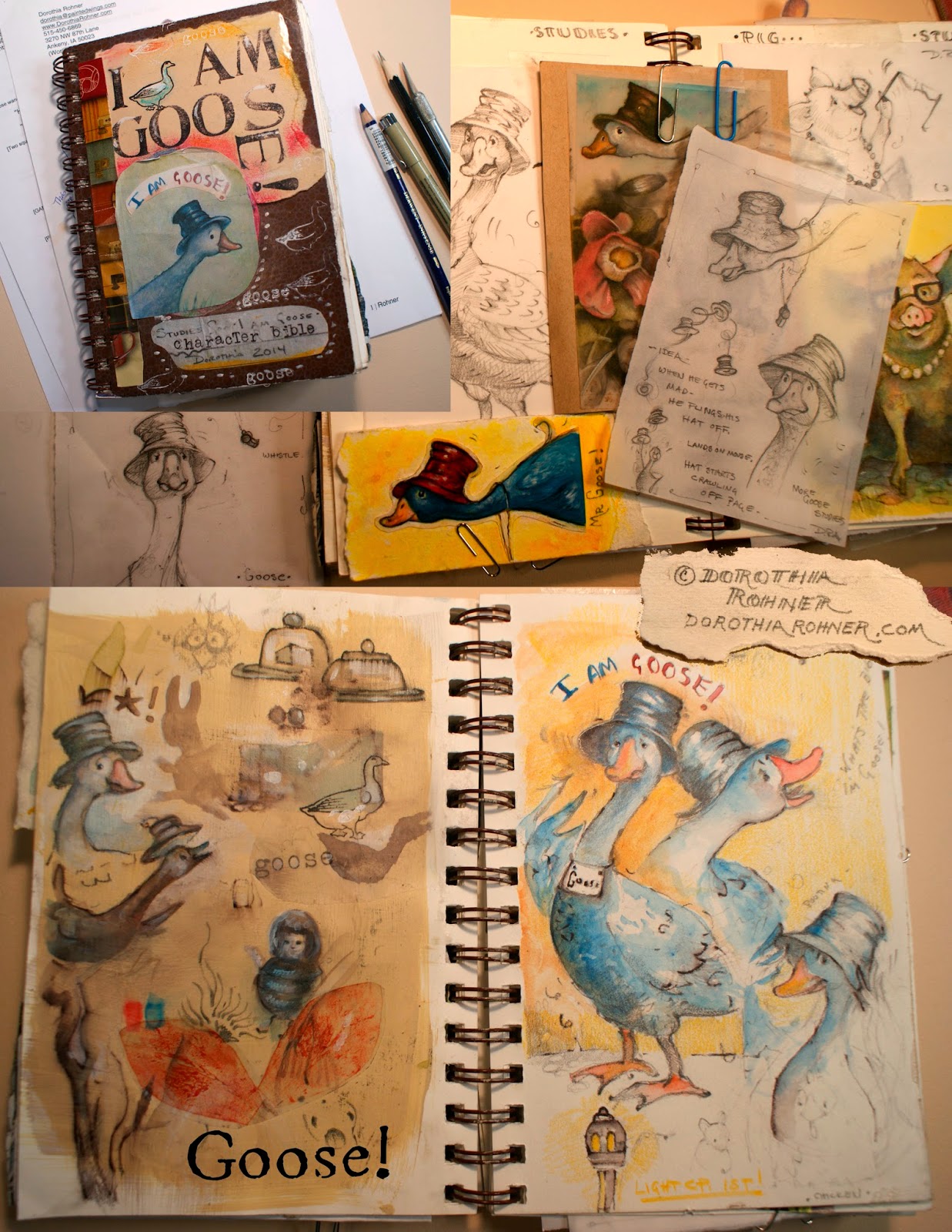
Below are some of the images from the pages from my character bible for I AM Goose!

Choose any size sketchbook. This is a  6"x 8" sketchbook. Next time I'll use a larger one.
I filled it up and ran out of room so ended up using paperclips and extra pockets to fit all the sketches.


I tested out lots of different styles and techniques for Goose.
I made notes on the medium used and jotted down what was working and what was not.


 More sketches and test palette for Rabbit, Pig, Dodo, Chicken, Squirrel and Pig.

  Color sketches with more of the characters. 


 I clipped out old photos of old buildings, sample palettes and played
with sketches and washes for the setting.

These are some of the pencil sketches for the characters. 


This has been a great learning process for me. My tendency is to finish off every detail in an illustration. But when I look back through this character bible, I realize that the loose sketchy images are my favorite. My next step will be to finish the storyboard, dummy book and final art to get it ready for submission.
Thank You  Judy Schachner for sharing your process at the 2014 SCBWI LA Conference. 
 
Dorothia Rohner enjoys illustrating and writing 
stories for children that combine nature and the magic of imagination.
Twitter: @dorothiar
Instagram: @dorothiar


Monday, March 24, 2014

The Value of Craft

The topic of the month on the Kidlit blog is craft. In this post, I’ll take a look at the definition, process, and importance of craft.


Here are a few definitions of craft that I like (all from Merriam-Webster.com):

“An activity that involves making something in a skillful way by using your hands” 
“Skill in planning, making, or executing”
“Skill in deceiving to gain an end <used craft and guile to close the deal>”
Ok, perhaps not that last one as much. But it does bring up a good point, that our ultimate goal as authors/illustrators is to tell stories that use illusion to make a kind of magic that the viewer wants to believe in. In my experience, the most reliable way to do this is through developing a solid foundation in craftsmanship.


Here’s a checklist I use when illustrating:
1. Idea (or project brief/manuscript)
2. Write outline/thumbnail

3. Sketch/brainstorm/experiment

4. Research 

5. Rewrite outline/thumbnail

6. Repeat steps 3 through 5 as many times as necessary

7. Finalize manuscript and thumbnails

8. Design characters, locations, and props. Make reference sheets for consistency.

9. Design compositions (at this point, evoke emotion using only basic shapes)
10. Line drawing
11. Value Study
12. Color Study
13. Final Painting


When I skip a step in this process, I find that I stop relying on the dependability of my craft and instead start relying on luck. I do think experimentation and a certain level of risk are important, but I try to balance them with organization and preparation.  


A teacher once told me, there are two ways to make a good image, you can either use time or method. If you use time, all you have to do is keeping working until you’re happy with your art…or pass out from exhaustion. If you learn the principles behind what makes art effective, then you can create a method that’s usually much quicker and less likely to make you pass out. That may sound really boring and stifling, but remember, you can have as many different methods as you want and you can also make experimentation part of your method.


Studying craft has reminded me of how important craftsmanship is to successful storytelling and communicating clearly with readers. I believe that every artist must find their own approach to craft, which I know is both encouraging and overwhelming. But I like to think it’s mostly encouraging, because you have the opportunity to create things no one has seen before in ways no one has ever imagined. So go out, do your picture book thang, and use craft as a tool to tell delightful new stories, I look forward to reading them!


To close, I leave you with a few inspirational quotes about craft that always make me feel motivated:
“Try not to think of your craft as a business. Try to think of it exclusively as ‘personal work.’" - Marshall Arisman
“There is no ‘gift’ or talent so great that it can dispense with the need for fundamental knowledge, much diligent practice, and hard effort.” - Andrew Loomis

“The greats weren't great because at birth they could paint. The greats were great cause they paint a lot.” - Macklemore & Ryan Lewis