Showing posts with label tips. Show all posts

Monday, January 27, 2020

Finding your Niche as an Illustrator - by Rob Sayegh Jr


Let’s not kid ourselves, it is really hard to find a way into the children’s publishing world. Through the SCBWI, mentorships, workshops, and basic trial and error, I have learned the steps to take to begin a career in children’s books. The harder part was to find how I could authentically embed my personality, style, and vision into my journey.

I love the moment when I realize why and how I am going to create something by exploring new possibilities within my creative process. It wasn’t until about a year and a half ago I was able to move past this idea of being stuck by anchoring myself to three things I felt extraordinarily passionate about. These three values now guide every piece of artwork that I show to an art director, my agent, my family, and social media. My guiding values help me translate how my process and experience from work that reflects who I am on and off the paper.

I found my guiding values by creating three circles in a Venn diagram, broken down into the three categories that make every great author/illustrator identifiable: genre, artistic style, and subject matter. I hoped to establish a baseline from which I could critique my work. I wanted to learn how each piece interacted with the diagram to remind myself to genuinely represent who I am in my work.

For each of the three circles, I didn’t think about marketable or trendy answers that paralleled today’s book lists. Instead, I thought about what I enjoyed creating and reading. It was very liberating to think this way. It was also the best way to get projects that matched my passions. Now, an art director might think that I would be the perfect candidate for a project because of what shows through in my portfolio. It was scary to define myself because it meant that there would be a lot of work that would not fit my niche. But sometimes, turning down the wrong project for me is for the best.

Below is a look into my thought process and what I made of the Venn diagram.

Genre:

What picture books YA novels do you love to read?

I adore funny and witty picture books. Jared Chapman, John Bond, Bob Staake, Dav Pilkey, and of course, the authors of the most fabulous horror book about a bunny ever written, Bunnicula by Deborah and James Howe I internalize stories and illustrations best as a reader when I laugh the cleverness of a joke or all the layers behind a good punchline. Whether a New Yorker cover or a silly advertisement, I appreciate the skill it took to create such a compelling story. It inspires me to show more layers in my work. I am experimenting with new ways to show that side of me.

My answer: Funny stories that appeal to both kids and their parents


Artistic Style:

How do you create your work? Who are your favorite illustrators?

This was the most challenging circle in my Venn diagram. The question that helped me the most was, “can I do this for 12 hours a day, every day?” I am not a detailed illustrator. I am not someone who loves spending days or weeks on a single image. I know what I liked as a viewer. Both as a child and today, I can stare at an Ezra Jack Keats or an Eric Carle book for hours. The simplicity and texture of each component on the page blow me away. Keats and Carle will always be who I aspire to be as an artist.

While I was creating the Venn diagram, I was also beginning to experiment with the idea of taking pictures of textures to use in my work. I would take photos on my commute from my job to my home in NYC on my phone to inspire my drawings that night. I didn’t exactly know how it was going to work out, but I loved the idea of bringing something personal to my illustration work.

My answer: Simple shapes and textures.


Subject Matter

What do you love to draw?

I would imagine this is the easiest question to answer for most artists. I think every illustrator has that one thing they love to draw. For me, it is dogs. I am DOG-OBSESSED. It’s something my friends and family know about me but also is something I love sharing about myself. I have two dogs and a dream of owning three more. I’ve worked at a dog toy company, and cannot pass a dog on the street without saying hello.

I used to always draw dogs, but I never paired the illustrations with textures, shapes, nor humor. They were just dogs on the page. There was no consistency. My challenge was to tackle all three parts of the diagram, simultaneously.

My answer: Dogs and animals (anything cuddly)

The Outcome


Once I had three giant circles in my notebook that said “funny, simple shapes and textures, dogs (and other cuddly creatures),” it was very easy to see the holes in my portfolio. Not one of my pieces held all three elements, which for me meant I was not putting out my best work,

The three circles became my mission statement. I still refer back to the statement as I create new pieces of personal illustration, promos, and client work. I needed to create a lot of new work for my portfolio,.I truly believe that the new work I have created since my Venn diagram has helped me find new client work through my rebranding journey.

What I have found is when I consistently push elements of who I am through my art, the easier it is for someone to get a sense of what I represent and why. It has been easier for me to pitch my work coherently and concisely. I don’t feel as bad when I don’t get a project because I know it wasn’t the best fit.

The diagram has also made me much more productive because I no longer struggle with how or what to start creating. My habits formed around what I love most, and I continue to build new techniques and understanding of my three anchor points. Where they have limited my focus, I feel they have allowed me to grow much further. The result is a richer, more engaged base and a professional community that has opened many doors for me.

I create more personal work that becomes part of my portfolio than ever before. On top of that, I am having more fun with all aspects of my author and illustration career because my passions weave through every step of my process.

Attached is a Venn diagram you can download and use for your reference. I hope this diagram helps you as much as it helped me.


Here are some of my pieces that represent my mission statement:


Rob Sayegh Jr is a former toy designer turned author and illustrator of children’s books. A 2019 SCBWI Mentee Award winner, Rob’s clients include Scholastic, Abrams, HMH, and more. Rob is represented by Justin Rucker of Shannon Associates.

You can see more of Rob’s work at www.robsayart.com and @robsayart on Instagram and Twitter.

Tuesday, July 23, 2019

Children's Book Portfolio: Flow

When creating a children's book portfolio there are three key elements to consider: format, content, and flow. This post is about flow. 


©Jen Betton


FLOW
Flow is the order in which the images are arranged – how you arrange your work showcases your storytelling ability, which is paramount in the children's book world. Treat your portfolio like a book! (While flow can also be applied to a website, the primary focus here is a physical portfolio.)

BEGINNING AND END:
It's good to start and end with an eye-catching piece, your very best work. Some people actually create a "title page" with an illustration and their contact information (Molly Idle does this!). After your intro, you want to arrange your work in a way that feels natural, leading from one to another as smoothly as possible. If you have series of images (and you should!!), then they naturally group together. After that, you can try different arrangements to connect images by composition, color, or content.

Examples: Each of these pairings involve two images which are not from the same series, but share a visual commonality.


©Jen Betton
These two pieces both have strong warm glow as well as human families.


© Jen Betton 
These two pieces have content similarity - a figure with hair blowing in the wind, as well as prominent blue tones. Even the composition has some similarities with the bottom weighting of the image. 


©Jen Betton
These two pieces share similar compositional elements - a curving form, single figure, with a white background. 

 © Jen Betton
These two pieces have color palette similarity, as well as the dots (of dandelions and fireflies) serving as a compositional similarity.

Example of a transition: The beginning and ending pieces in this sequence are each from a series. The two in the middle serve as a transition from the first series to the second. The first two images share a color palette and the outdoors, the middle two share a single child figure doing a similar action, and the last two images share a color palette and stars.


©Jen Betton

Here is a possible layout of an entire portfolio. Many other arrangements would also work. It starts with a single image, moves to a kid series, three additional single images, then an animal series, a single image to transition to a third series, and then a final, single closing image.


©Jen Betton

SECTIONS:
If you have two separate, consistent styles you will want to create separate sections for them (they don't have to have a physical divider, but don't intermingle the images). You might have a section for your middlegrade vs. picture book work, or your black and white vs. your color images. Eliza Wheeler and Maple Lam both separate their portfolios into "light" and "dark" sections for the more colorful, lighthearted work, and the more monochrome, moodier work.

There are zillions of ways to arrange any given set of images, but taking a little time to lay it out carefully can really add cohesiveness to your portfolio! Flow is important enough that I will remove images that I'd otherwise include in my portfolio if they don't seem to fit into the flow.

For more info on portfolios:

Portfolio Prep:

Past Portfolio Winners: 
Editing Your Portfolio - by Andrea Offermann (winner of the 2013 SCBWI portfolio showcase)
Mentee vs Grand Prize Winner Portfolio - by Juana Martinez-Neal (winner of the 2012 SCBWI portfolio showcase)
Portfolio Comparison - by Eliza Wheeler (winner of the 2011 SCBWI portfolio showcase)

More Conference Tips:
For First Time Attendees - by Debbie Ohi 
The Portfolio Showcase - by Debbie Ohi 

After the Conference: 
What next? - by Jen Betton


P.S. The storytelling aspect is one reason why I don't use process work in my portfolio – it can disrupt the story. It is a great thing to include on your website, but since art directors mostly care about the finished image I do not include it in my physical book.

....................................
Jen Betton wrote and illustrated HEDGEHOG NEEDS A HUG (Penguin-Putnam) and illustrated TWILIGHT CHANT by Holly Thompson (Clarion-HMH).
You can find more of her work here:
www.jenbetton.com
www.facebook.com/jenbettonillustration
@jenbetton

Monday, April 23, 2018

The Power of Routine: Part 2

Happy spring! In November, I posted the first part of this article which discussed the power of having long-term goals, breaking them down, and setting a routine for yourself so that you can be the most productive version of you in the studio. You can find it here if you want to refresh your memory.

Since November, I have asked other artists how they tackle these same challenges.
Here are some thoughts from kid lit illustrators, Suzanne Kaufman and Pamela Goodman.

Suzanne Kaufman

Suzanne recently completed the beautiful illustrations for 100 Bugs! A Counting Book. It is the first nonfiction book
she has illustrated! Awesome! You can find more of her bright, expressive work on Instagram and Twitter.

Q: How do you break down your days? Do you have a specific set of tasks for
each day before you dive into work?
I try to work out before family gets up. I also sneak in a mom breakfast most weeks
before they get up for school.
Mondays, I still teach a full day as I love the inspiration my students give me.
Tuesday through Friday I break my day into hour and half chunks based on the
video by John Cleese.
I follow a lot of what John Cleese says about creativity and time management.
Check out this video: https://www.youtube.com/watch?v=Pb5oIIPO62g
Another great video about time management is by Jake Parker.
End of day on Fridays, I write a schedule for the next week.
I check email for only 15 minutes.  Later in the day. I do get pop up notifications, so I can
respond quickly to my editors/art directors but other than that I ignore email til
the end of the day when I feel unfocused.
Q: When do you feel most productive?
Right before my kids come home from school.  I wish I was kidding. Also, probably
before sunrise or early morning after my kids are off at school is another good time.
Q: How many hours, on average do you spend creating? Marketing?
This is tough...my recommendation is not to think hours but quality of work. I used to
think I wasn’t working enough hours or working hard enough
and my work suffered.  I never have a normal week, so I am more kind
to myself and I look at the quality of the work versus quantity. Just have the
faith that it will all get done and most times, it does.  This has helped me a ton.
Right now, in my career I am terrible at budgeting time for marketing.
I have decided to focus on my books and hope that doing great
work will get me more work versus sending out postcards or posting more on social media.
Q: What is your favorite kind of task to do?
I love to play.  This can’t be done under a tight deadline.  I would recommend giving
yourself daily sketch ideas that can be used to experiment with material, composition for future books.  This play time I have used later in production. Examples is the endpaper
for 100 bugs and the Christmas Tree in Naughty Claudine.  Both were
things I had never done before and used my playtime “Daily Sketch” to just go for it.
If you are not published I would use daily sketches to add the things that are missing.  
I did this to add animals, environments, kids etc to build my portfolio. Since these were just
sketches I was fearless and picked my favorites to build future stories
and my portfolio around.  I owe this idea all to Lucy Ruth Cummins an
Art Director at Simon and Schuster.
Q: Do you have a method for motivating yourself to do tasks you
really don't want to do?
Lunches with friends.  Also, it is perfectly ok to choose not to do something
and that is ok.
Q: Do you have a lull in your day where it's hard to focus? If so, what do you
do with that time?
Afternoon and before lunch I struggle as I love lunch and dinner.  I go to lunch,
call illustrator pals, take walks with illustrator friends
and just hang out with my daughters.  
This is a good time to reconnect with the real world.
Q: What is your favorite thing about freelancing?
I love not driving in the horrible Seattle traffic.  For almost twenty years I spent
sometimes a few hours a day instop and go traffic with a lot of angry people.
Also, I love I get to see my girls grow into amazing people.

Pamela Goodman

Pamela illustrated this beautiful book, Love You From Right Here about foster kids and parents. (It is so sweet I still cry when I read it.)
You can get a copy here. Look for more of Pamela’s adorable illustrations on Instagram and Twitter.

my schedule:
keeping it consistent is the hardest, but once I get into a rhythm (doing it for at least a week)
it gets easier. My schedule is usually (ideally) like this:
- wake up, have coffee/ eat
- walk the dog
- shower/ get ready for “work” (getting dressed in non-pajama clothes
has really helped me get into Work Mode!)
- arrive at “work” usually by 10am, put on some music with coffee/tea
- sit at my art desk (not my computer!) and do some sketching warmups
(either ideas I have in my head, doodles,
or using a prompt word) Sometimes these doodles will turn into a story or illustration later
- lunch
- check email (just once a day! not all day long! it’s too easy to get lost on the computer )
-  return to a long-term ongoing project
- OR if I have major errands, or its my grocery shopping day I do it in afternoon after lunch
-try to wrap up my day by 5pm/ start dinner

other notes on schedule:
To avoid the feeling of house chores or laundry staring at you during the workday I assign a
day for cleaning. Friday is my cleaning/ laundry day- I try not to let any
kind of chore or cleaning distract me until Friday.
(its HARD but it has really helped!! plus its done for the weekend and
I can relax on Saturday) Tuesday is grocery shopping day-
same thing try to finish what’s in the fridge all
week and NOT run out to shop every other day.

my approach to marketing:
so far the marketing that has worked for me (gotten me actual jobs) has been word of mouth
through other illustrator friends, people finding me on facebook and instagram
and childrensillustrators.com I have also done postcards, but nothing
panned out from them so far

my best advice to freelancers starting out full-time:

Stick to a schedule, once you’ve found something you like. and set your working hours.
Don’t answer the phone or texts from friends/ family unless its work related
(you are at WORK duh! so they gotta wait)
- you have to make work to get work, so if you don’t have an immediate paid project,
make one up. Make it look like you’re busy and in demand, pretty soon you will be
- don’t wait around for someone to take you seriously as a professional, take yourself
seriously (that goes for how much you charge too. )
Someone once told me this saying: “Act like a Pro, bill like a Pro"


~Jeslyn Kate


Jeslyn Kate writes/illustrates for children and teaches art.
You can find her work at these different locations:
Website:www.jeslynkate.com
Instagram: Jeslyn Kate
Twitter: @jeslynkate
Facebook: https://www.facebook.com/jeslynkateart

Monday, July 3, 2017

SCBWI Conference Tips!

Your bags are packed, your portfolio perfect (you might just fiddle with the order one more time), your business cards in hand.... all that's left to do is go, right? After attending both the LA and NYC conferences several times, here are a few things I've found helpful!


Be brave! Talk to people around you, be friendly! You never know who you might meet! At my first conference, when I didn't know a soul, I met dynamite illustrator Richard Jesse Watson this way. The folks who attend SCBWI tend to be almost universally friendly and welcoming. I've met some of my very best buddies at these conferences.
Awesome illustration buddies and fellow mentees Maple Lam and Lisa Anchin (and me).
Always have a backup portfolio and dummy: even if it is just on your phone. You never know who might be interested in seeing it and you don't want to have to say "well, if you go to the portfolio showcase..." (and you should definitely put your work in the portfolio showcase!)

Have your business card stashed in the front of your conference badge: it fits right under your name, and if you have an image on it, then not only can people can pick you out as an illustrator, but they will connect your name with your work (it is really exciting when someone looks at your card and says, 'hey, I know your stuff!').
Bring LOTS of business cards and postcards – especially if you are in the portfolio showcase. It really stinks when you run out and then someone you really want to connect with asks for your card!

Be on time! The portfolio showcase is only open to general conference-goers for about an hour, so be on time if you want to see all the books (plus they announce the awards at the beginning). The keynotes often run overtime, but the workshops will still start as scheduled! It is also easier to say hello to the speaker before the talk – afterwards they will be mobbed!

Do it all!!! Sign up for a critique, put your book in the portfolio show, and go to the social events. Often the optional elements of the conference are my favorite parts.

Get some rest. The conference is exhausting! While you want to take advantage of everything you can, it's ok to take a break and recharge a bit. Also, you can meet some pretty amazing illustration folks out on the pool deck (just sayin'). Also, bring a sweater – sometimes those rooms are coooooold!

Do homework prior to networking: look at the faculty bios and decide who you want to meet. Look them up on twitter so you know what they look like and you can walk up to them in the hall. Read their tweets and books so you have something to talk about. Go to their workshops! Look up the twitter hashtag for the conference (#la17scbwi this year) and join in the conversation.

Be receptive to feedback: whenever someone spends the time to review your work, take notes, listen, and don't be defensive. Send thank you notes to anyone who critiqued you: As well as just being a nice way to show your appreciation, most people don't do this, so it helps you stand out. It is also a chance to show another image to them. One year I got a personal letter back from an art director (decorated with cute stickers!) responding to my thank you note.

After the conference, follow up: look up folks you connected with on facebook or twitter, or send a postcard. I find it helpful to write a tidbit of info on a person's business card or postcard when I get it, which makes it easier for me to relate the name to the conversation we had (which can be important if you pick up 50+ business cards over the weekend).

For more info on:

Portfolio Prep:
Portfolio Tips from SCBWI Mentorship Winners - SCBWI Insight
Editing Your Portfolio - by Andrea Offermann (winner of the 2013 SCBWI portfolio showcase)
Mentee vs Grand Prize Winner Portfolio - by Juana Martinez-Neal (winner of the 2012 SCBWI portfolio showcase)
Portfolio Comparison - by Eliza Wheeler (winner of the 2011 SCBWI portfolio showcase)
Creating a Children's Book Portfolio - by Jen Betton

More Conference Tips:
For First Time Attendees - by Debbie Ohi 
The Portfolio Showcase - by Debbie Ohi 

After the Conference: 
What next? - by Jen Betton

I encourage everyone to go to both their regional and national SCBWI conferences! I'm so sad I won't make it to the LA conference this year, but hope to see you there next year!
..........................................
Jen Betton wrote and illustrated HEDGEHOG NEEDS A HUG (Penguin-Putnam) coming in summer 2018, and illustrated TWILIGHT CHANT by Holly Thompson (Clarion-HMH) coming spring 2018.
You can find her here:
www.jenbetton.com
www.facebook.com/jenbettonillustration
@jenbetton

Saturday, April 8, 2017

Fresh Eyes

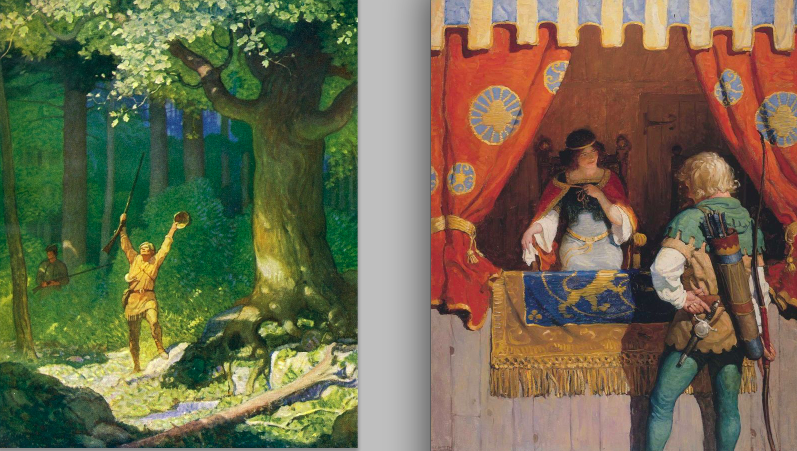
Sometimes it's hard to see the problems in your own work. We get too close to it, look at it for so long that mistakes can look normal. Here are several tricks to get a fresh look at your work: We'll use a couple of N.C. Wyeth's paintings as examples. 
1. Look at it upside down or in a mirror:
Flipping it around may help you see your piece differently, especially when it comes to noticing big compositional shapes. A mirrored version often will show if you've tilted the composition or if you have some asymmetry problems with figures.
2. Look at it across the room:
"Get back from your work" was a constant refrain in my figure drawing classes. A little distance helps you see the piece as a whole, and look at in terms of composition or proportion, rather than getting caught up in the details. If you are working on the computer, you can also try zooming way out.
3. Squint:
If you look at your piece out of focus, it melds the details into the larger shapes, once again helping you focus on the larger elements of your piece. This is very helpful for checking your values.
4. Change it to black and white:
This one focuses on your value structure. If the values aren't strong your composition is probably suffering, or it may even be hard to "read" the image.
I hope these tips are helpful! I was reminded of the upside down trick by Art Director Cecilia Yung, who likes to check artist's designs that way.
...............................
Jen Betton writes and illustrates for children. Her debut author-illustrator book, HEDGEHOG NEEDS A HUG will be published by Putnam in 2018. She is also currently illustrating TWILIGHT CHANT for Clarion Books. You can find her work at
 www.jenbetton.com
@jenbetton on Twitter
www.facebook.com/jenbettonillustration on Facebook