Showing posts sorted by relevance for query portfolio advice. Sort by date Show all posts
Tuesday, June 19, 2018
SCBWI Summer Conference: Portfolio Advice, Tips For Newbies and Second-Timers, and a CHALLENGE for the Many-Timers - by Debbie Ridpath Ohi
Just a month and a half until the SCBWI Summer Conference in Los Angeles! Who else is going? And isn't the header art wonderful? It was created by our own Robin Rosenthal (Mentee Class of 2014).
I'll be on faculty for the first time: I'm giving a Social Media Master Class for authors and illustrators, a Photoshop session with advice I wish I knew when I first got started in digital art, and am also a Mentor in the just-launched SCBWI Social Media Mentorship For Illustrators award. Deadline for the latter is July 1st; see details here.
To those attending the conference for the first time: I'M EXCITED FOR YOU! As some of you already know, my career got jumpstarted at an SCBWI conference. I started the blog you're reading now because the 2010 winners of the SCBWI Illustration Mentorship Award got along so well, and we wanted to keep in touch (this blog is not officially associated with the SCBWI). I'm grateful for Jen Betton, Meridth McKean Gimbel, Ana Aranda, Susie Ghahremani and others who manage the blog and Kidlitartists social media now, as well as those Mentees (past and present) who contribute.
Speaking of Jen Betton, who manages the posting schedule for the KidLitArtists blog: Jen was another person whose career got jumpstarted at an SCBWI Conference! Congrats to Jen, whose debut solo picture book, HEDGEHOG NEEDS A HUG, launches TODAY from Putnam/Penguin!
ENTERING THE PORTFOLIO SHOWCASE? HERE'S SOME USEFUL ADVICE:
Everyone who contributes to this blog was chosen for the SCBWI Illustrator Mentorship program, and they were chosen based on their portfolios -- so I encourage you to read over posts in our blog for advice and inspiration, especially posts tagged with portfolio-advice. Some of the posts you should check out:
Mentee Portfolio vs Grand Prize Winner Portfolio - by Juana Martinez Neal (2012 Portfolio Showcase winner)
A Few Thoughts On Editing Your Portfolio - by Andrea Offermann (2013 Portfolio Showcase winner)
Portfolio Comparison: What Made An SCBWI Winner - by Eliza Wheeler (2011 Portfolio Showcase winner) -- Eliza is one of the keynote speakers at this year's Summer Conference!
Portfolio Tips From SCBWI Mentorship Winners - Tips from Brooke Boynton Hughes, Jen Betton, Maple Lam, K-Fai Steele, Meridth Gimbel and me.
Even if you don't win an award at the Showcase, be assured that industry people have been looking at your work. One reason I strongly advice bringing postcards is because agents, editors and art directors DO pick up postcards. Even if they may not be able to take you as a client or hire you for a book project right then, your work intrigues them and they may end up contacting you weeks or months later (THIS HAS HAPPENED). Others in the industry will also see your work and may end up recommending you to their agent, editor or art director. I also know at least one art director who does keep track of illustrators whose work intrigues him (but isn't quite ready), to see how portfolio work progresses and evolves.
And most of all, remember that just ENTERING the portfolio showcase is an accomplishment. You're putting yourself out there, and that takes courage.
A FEW TIPS FOR SCBWI CONFERENCE NEWBIES:
I've posted advice in my Inkygirl blog in the past, but wanted to post an updated version here.
Be brave and make the first move. You'd be surprised at how many other attendees feel exactly the same way as you do. Introduce yourself to people you sit beside, stand in line with, notice standing alone.
TAKE BUSINESS CARDS. Yes, even if you aren't published yet. We're all going to meet a lot of people over the weekend, and taking away a business card from an encounter or introduction will help the people you meet remember you. If you're an illustrator, take postcards or make sure a sample of illustration style is on your business card.
Have realistic expectations. Don't expect to be "discovered" at the conference.
But most of all: TRY TO HAVE FUN.
Also see my Tips For Introverted Children's Book Illustrators attending the SCBWI Summer Conference For The First Time and Jen Betton's SCBWI Conference Tips.
A FEW TIPS FOR SCBWI CONFERENCE SECOND-TIMERS:
Don't get offended or disheartened if people you've met before don't remember you. This is something I've learned from both sides. As a 2nd- and 3rd-timer (and so on), I've sometimes gone up to a person or group I've met and had my confidence deflated when it becomes clear they don't remember me at ALL from the previous year. My inner reactions ranged from embarrassment, humiliation, irritation, frustration and even brief anger ("I guess I'm just NOT IMPORTANT enough for xxx to remember!! Hmph.").
Having attended many times now, I've learned the following:
- I'm terrible at remembering people unless I've had multiple conversations or interactions with the same person.
- Even then, especially if I'm tired or am in a noisy crowd (remember what I said earlier about being an introvert?) or have met many new people in a row just before, I may still forget having met someone before.
I still accidentally re-introduce myself to people whom I've met before, sometimes whom I've met EARLIER IN THE CONVENTION. I'm always horribly embarrassed when this happens.
Make sure your name badge is easily visible.
Also, when I approach someone whom I've met before but with whom I don't have constant contact, I usually try saying something that will help remind them of our mutual context, or remind them of having met at xxx. Until I'm sure they actually do remember me, I try very hard NOT to put them on the spot (e.g. I don't say, "So, what did you think of my most recent post?" etc.).
When someone does this to me (subtly or unsubtly :-) setting the context and helping me remember), I immediately feel more at ease with them and am more likely to want to chat with them in the future.
Another tip: if someone DOES remember you, never assume that they're up-to-date on all your exciting news. I've had the occasional person react badly when they realize I'm not aware of their new book ("?? But I posted it all over Facebook!") I never assume anyone reads all my posts or keeps up with all my news. People have busy lives and different priorities.
Something else I've learned: even so-called Big Name authors and illustrators can be insecure. I am faaaar from being a Big Name, but having had a bit more experience at conference-going now, I also realize how some of the Big Name types who seemed standoffish to me actually weren't.
Be gracious, be forgiving and try very hard to assume the best about a person rather than the worst.
And I apologize ahead of time if I don't remember your name or re-introduce myself. :-\
***** A CHALLENGE TO THE "MANY-TIMERS" OUT THERE ****
Try to remember what it was like when you attended your very first event, or how insecure you felt in the beginning. Then make it a personal challenge to find at least one lost-looking or nervous conference newbie who is sitting or standing alone. Introduce yourself, chat with them, find out what they're working on, perhaps (if appropriate) offer some advice.
Give good karma and it WILL come back to you.
And if you see me at the SCBWI Summer Conference this year, please do say hi!
--------------
Debbie Ridpath Ohi wrote and illustrated WHERE ARE MY BOOKS? and SAM & EVA. Her illustrations have appeared in children's books by Judy Blume, Michael Ian Black, Rob Sanders, Aaron Reynolds and Lauren McLaughlin, among others. Most recent: I'M SAD written by Michael Ian Black (Simon & Schuster). Current projects: Illustrations for I'M WORRIED (part of the I'M...book series) and a broken crayon picture book with Linda Sue Park. More about Debbie at her website, blog about writing & illustrating children's books, Twitter, Facebook and Instagram.
Wednesday, June 28, 2017
Portfolio Showcase Advice from Jennifer Laughran of Andrea Brown Literary
As any reader of KidLitArtists knows, one of the most thrilling parts of attending SCBWI conferences as an illustrator is an opportunity to show your work alongside your peers at the Portfolio Showcase. Find the guidelines for submission here.
In addition to the satisfaction of putting your hard work together and sharing it with the world, the showcase also presents opportunities to win awards and scholarships — for all levels of experience, from student to seasoned professional.
FYI, all the artists and authors blogging at KidLitArtists are former mentorship winners from the SCBWI portfolio show. I really can’t speak highly enough about this opportunity and community!
A portfolio mentorship entails the opportunity to get detailed, focused feedback from the conference Illustration Faculty during the conference. Consider more than just the technical specifications when you enter your portfolio in this show; each judge and visitor comes to the portfolio show with her own sense of what she is looking for.
To find out a bit more, I interviewed Jennifer Laughran of Andrea Brown Literary about what an agent attending the conference might be looking for, and for her feedback and advice for illustrators entering this show:
Susie: Please tell us a little bit about yourself.
Jennifer: I'm a senior agent at Andrea Brown Literary Agency. I rep authors and author-illustrators for books from PB through YA.
Susie: How much of your roster is made up of illustrators (as opposed to authors, and author-illustrators)? If you’re primarily interested in author-illustrators, do you want to see a book dummy?
Jennifer: My own list is primarily authors - I do rep about 15 author-illustrators. I'd be open to somebody who was "just" an illustrator, but might have goals to be an author as well. As an agency we rep about 100 illustrators - you can see our roster here.
If you are querying an author-illustrator piece, I'd want to see the text, a sketch dummy, and a couple of finishes.
Susie: When browsing the portfolio show, what are some of the key things you look for (as an agent, or as a judge)?
Jennifer: I like a strong sense of MOVEMENT in illustration - dynamic pictures, rather than static. I like a picture that really tells a story, rather than just being a beautiful image or decoration. The thing is - lots of people are good at design and good at drawing, and might make swell editorial artists, or be great at surface design, textiles, cards, etc... but that DOESN'T automatically mean that they will be awesome at children's book illustration.
Susie: What’s something you recommend for the portfolio that illustrators might not think of doing?
Jennifer: It can be very helpful to see a couple of page turns. If you aren't an author, consider doing a couple of spreads from a well-known fairy or folk tale in your own way.
Don't forget - illustration isn't JUST for picture books! It can be fun to see how an artist might approach book jackets and/or b+w interior spot art. If these are things that appeal to you, you might find your own way to interpret a "classic" book jacket or iconic literary scene.
Susie: What are common portfolio or book dummy missteps you recommend illustrators avoid?
Jennifer: I think sometimes illustrators put in everything and the kitchen sink just so the portfolio is "big" but some pieces are obviously of lesser quality, or in a more amateur style, etc. I'd rather have fewer pieces of higher quality, than a portfolio bursting with filler.
Susie: What subjects would you like to see appear more in portfolio pieces?
Jennifer: For illustrators doing humans, I'd like to see diversity.
Susie: As an agent, what do you look for in a takeaway promo piece?
Jennifer: I look for pretty art and contact information. And if you are already agented PLEASE put your agent info on there, too.
Susie: Any other general SCBWI conference advice?
Jennifer: Have fun. Stay sober. Drink lots of water.
Susie: Thank you, Jennifer! Good luck to all the illustrators working hard to be part of this amazing show!
For more about #LA17SCBWI, check out the official SCBWI blog. For more portfolio advice, read: Portfolio Tips From SCBWI Mentorship Winners.
Registration is still open - get all the details on the 2017 SCBWI Summer Conference, July 7-10, here.
This post was cross-posted to the official SCBWI Team Blog.
Susie Ghahremani is an award-winning illustrator and obviously also a major design nerd.
Her author-illustrator debut titled STACK THE CATS was just named one of Amazon's Best Books of the Year (so far) for 2017!
For more about Susie and her books and art, visit her site at boygirlparty.com or follow at @boygirlparty on instagram, twitter, or Facebook for the latest updates.
In addition to the satisfaction of putting your hard work together and sharing it with the world, the showcase also presents opportunities to win awards and scholarships — for all levels of experience, from student to seasoned professional.
FYI, all the artists and authors blogging at KidLitArtists are former mentorship winners from the SCBWI portfolio show. I really can’t speak highly enough about this opportunity and community!
A portfolio mentorship entails the opportunity to get detailed, focused feedback from the conference Illustration Faculty during the conference. Consider more than just the technical specifications when you enter your portfolio in this show; each judge and visitor comes to the portfolio show with her own sense of what she is looking for.
To find out a bit more, I interviewed Jennifer Laughran of Andrea Brown Literary about what an agent attending the conference might be looking for, and for her feedback and advice for illustrators entering this show:
![]() |
| Jennifer Laughran of Andrea Brown Literary |
Susie: Please tell us a little bit about yourself.
Jennifer: I'm a senior agent at Andrea Brown Literary Agency. I rep authors and author-illustrators for books from PB through YA.
Susie: How much of your roster is made up of illustrators (as opposed to authors, and author-illustrators)? If you’re primarily interested in author-illustrators, do you want to see a book dummy?
Jennifer: My own list is primarily authors - I do rep about 15 author-illustrators. I'd be open to somebody who was "just" an illustrator, but might have goals to be an author as well. As an agency we rep about 100 illustrators - you can see our roster here.
If you are querying an author-illustrator piece, I'd want to see the text, a sketch dummy, and a couple of finishes.
Susie: When browsing the portfolio show, what are some of the key things you look for (as an agent, or as a judge)?
Jennifer: I like a strong sense of MOVEMENT in illustration - dynamic pictures, rather than static. I like a picture that really tells a story, rather than just being a beautiful image or decoration. The thing is - lots of people are good at design and good at drawing, and might make swell editorial artists, or be great at surface design, textiles, cards, etc... but that DOESN'T automatically mean that they will be awesome at children's book illustration.
![]() |
| Photo by Debbie Ridpath Ohi from this phenomenal, must-read post! |
Susie: What’s something you recommend for the portfolio that illustrators might not think of doing?
Jennifer: It can be very helpful to see a couple of page turns. If you aren't an author, consider doing a couple of spreads from a well-known fairy or folk tale in your own way.
Don't forget - illustration isn't JUST for picture books! It can be fun to see how an artist might approach book jackets and/or b+w interior spot art. If these are things that appeal to you, you might find your own way to interpret a "classic" book jacket or iconic literary scene.
Susie: What are common portfolio or book dummy missteps you recommend illustrators avoid?
Jennifer: I think sometimes illustrators put in everything and the kitchen sink just so the portfolio is "big" but some pieces are obviously of lesser quality, or in a more amateur style, etc. I'd rather have fewer pieces of higher quality, than a portfolio bursting with filler.
Susie: What subjects would you like to see appear more in portfolio pieces?
Jennifer: For illustrators doing humans, I'd like to see diversity.
Susie: As an agent, what do you look for in a takeaway promo piece?
Jennifer: I look for pretty art and contact information. And if you are already agented PLEASE put your agent info on there, too.
Susie: Any other general SCBWI conference advice?
Jennifer: Have fun. Stay sober. Drink lots of water.
Susie: Thank you, Jennifer! Good luck to all the illustrators working hard to be part of this amazing show!
![]() |
| Grand Prize winner at #LA16SCBWI, Oge Mora, a student of the Rhode Island School of Design |
For more about #LA17SCBWI, check out the official SCBWI blog. For more portfolio advice, read: Portfolio Tips From SCBWI Mentorship Winners.
Registration is still open - get all the details on the 2017 SCBWI Summer Conference, July 7-10, here.
This post was cross-posted to the official SCBWI Team Blog.
Susie Ghahremani is an award-winning illustrator and obviously also a major design nerd.
Her author-illustrator debut titled STACK THE CATS was just named one of Amazon's Best Books of the Year (so far) for 2017!
For more about Susie and her books and art, visit her site at boygirlparty.com or follow at @boygirlparty on instagram, twitter, or Facebook for the latest updates.
Thursday, May 10, 2012
Catching up with Debbie Ridpath Ohi
For those new to our blog, Debbie Ohi is one of our contributors and was a recipient of the SCBWI Mentorship Award at the 2010 Summer Conference. We’d like to catch up with Debbie and ask her a few questions about the Mentorship experience and about what she is up to these days.
Advice #3: "Don't try to be too polished."
KidLitArtists: Did the feedback you receive during the mentorship critiques either change or confirm the direction of your illustration? Are there any specific examples you can share?
Debbie: Yes! I found the feedback from my mentorship critique immensely useful and illuminating. Some of the advice which had an immediate impact on my work or which I've been trying to put into practice as much as possible, including:
Advice #1: "Your business card needs a revamp."
Actually, Cecilia Yung (Art Director at Penguin) hated (yes, HATED) my biz card. She said later that she disliked my card so much that she had to go back and look at my portfolio again at end of the judging session because she wanted to remind herself about why she had picked me for the Mentorship Program.
My biz card the Mentors hated was WAY too cluttered. So I had a graphic designer friend of mine revamp it to include a lot more white space. The writer half of my brain rebelled ("what?!? but but but you have to include more info!!") but I pushed her down.
Advice #2: "You need to show a story sequence."
The Mentors all liked the story elements implied in my single drawings, but I had no story sequences in my portfolio. They were all just one-offs, like greeting card images. So for my next portfolio showcase, I made sure to include sequences of images that told a story.
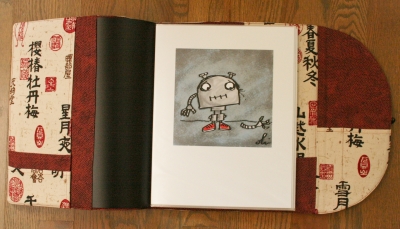
Example: Here's the robot image I had in my original portfolio:
For my revamped portfolio, I turned this into a sequence instead:
Advice #3: "Don't try to be too polished."
I should point out that this piece of advice is specific to my style of artwork. Or styles, that is. I have multiple styles, but the one that seems to attract the most attention is my very rough and sketchy style.
And I am once again grateful to my friend Beckett Gladney for helping me put together that portfolio. She chose images I would never have chosen myself -- I would have opted for what I considered my more polished pieces.
One of my Mentors (Cecilia Yung) even advised me against taking art courses or getting critiques at this point, since I might lose the "pizazz" that was so appealing in my current work.
Justin Chanda felt similarly about my work during the I'M BORED creation process. My early sketches were too tight and he encouraged me to loosen up, to recapture the spontaneous look in my portfolio drawings.
The challenge, I found, was to keep my drawing style spontaneous-looking even if I had to redraw the same image many times.
KidLitArtists: Getting such specific and direct feedback on your work, did you find the experience enlightening? Affirming? Confusing? Conflicting? _______ (fill in the blank)? Why?
Debbie: During the Mentor critique sessions, I did notice that some of the advice contradicted, but this was mainly about particular aspects of specific pieces.
Most of the overall critique comments overlapped, however, and that was advice to which I paid the most attention.
KidLitArtists: Have you seen a shift in your work since you were mentored?
Debbie: Yes, definitely. Another influencing factor: I was offered a book contract around the same time that I participated in the Mentorship critique sessions, so I was also learning a great deal from working on I'M BORED with art director Laurent Linn and editor/publisher Justin Chanda at Simon & Schuster Books For Young Readers.
Other changes in my work that I haven't already mentioned above:
I've been drawing a LOT more, not just for work but also for the fun of it. I try to post a Daily Doodle on DebbieOhi.com every day as well as do more drawing just for myself.
The Illustrators' Intensives at the SCBWI Summer Conference in 2011 inspired me to do much more life sketching and experimentation with different techniques and styles.
KidLitArtists: What kinds of projects are you working on now?
Debbie: I'm writing AND illustrating a picture book for Simon & Schuster Books For Young Readers! Very excited about this!!! Plus I also have a contract to illustrate another book for them; the particular project is still to be determined.
For those interested, I'm going to be blogging about the whole process in Inkygirl.
KidLitArtists: Is there anything, looking ahead, that you’re excited to be working on?
Debbie: See above. :-)
Recent work I'm excited about:
| Cover of I'M BORED |
Illustrating I'M BORED, a new picture book from comedian/actor/writer Michael Ian Black, coming out from Simon & Schuster Books For Young Readers in Sept/2012. I'm posting about the process (with photos, sketches, interviews, comics, etc.) in my I'M BORED Scrapbook at http://debbieohi.com/boredbook .
Also, my illustrated YA short story KODAMA was included in teen fiction anthology TOMO: Friendship Through Fiction (Stonebridge Press, Mar/2012).
KidLitArtists: Is there any type of illustration (or other work) that you’re hoping for in the near future?
Debbie: In addition to picture book illustration work, I'd love to do illustrations for chapter books and novels.
KidLitArtists: Last, please tell us where we can find you online.
Debbie: Jumping-off point for all my projects as well as sample art: http://DebbieOhi.com
My blog for children's/YA writers and illustrators:
MiG Writers (middle grade and YA author group)
Thank you for sharing with us Debbie!
Saturday, September 4, 2010
How a rejection got me a book deal: My career-changing SCBWI Summer Conference experience - by Debbie Ridpath Ohi
SATURDAY, SEPTEMBER 4, 2010 AT 3:55PM
Originally, I wanted to participate in the manuscript critique program at the SCBWI Summer Conference in L.A. This year, I was excited about submitting pages from a new project: a middle grade humor-mystery illustrated by cartoons. Worked hard to get the pages finished, and then paid to have it couriered it to the SCBWI office to make the deadline.
Sadly, I had misread the submission rules. The hardworking staff at the SCBWI office called to let me know. Illustrations were not allowed for any type of manuscript submission and no, not even a one sample illustration at the end. Disappointed, I told them that I had to withdraw from the critique program.
When I told my illustrator friend, Beckett Gladney, she suggested I submit something to the Illustrator Portfolio Showcase at the convention. I told her I wasn't good enough, but she and my sister disagreed. My next excuse: lack of time. Beckett said she'd help me.
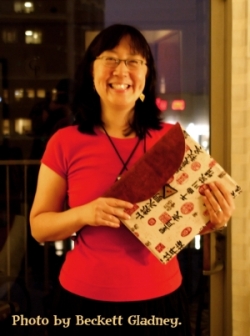
I didn't have a proper online portfolio, so Beckett went into my Flickr account and chose images she thought were my strongest. Then she printed them out and created a gorgeous custom-made cover for my portfolio (she sells others in her Etsy shop), if anyone's interested). The night before the Portfolio Showcase, we spread the pictures out on the floor and decided on the order.
To my utter shock, I ended up winning anHonor Award (one of the two runners-up) and a Mentorship Award.
Because I hadn't read the schedule properly, I missed the award announcements. I arrived after they were over, and started browsing porfolios. Oh geez, I thought. These are all so good. What was I THINKING, entering my work in this event? I purposely didn't look for my own portfolio because I was too embarrassed.
Then Beckett grabbed me, all excited, and said that my portfolio was up front on the winners' tables. At first I thought there must have been a mistake. Then I was convinced I was dreaming (seriously, no lie).
Because here's the thing: up to this weekend, I had always considered myself mainly a WRITER. Yes, I did webcomics and some client work, but never thought about doing children's book illustration because I had no art training.
The next morning, the six chosen mentees met with the six mentors for our one-to-one portfolio critique sessions: Cecilia Yung, Art Director and VP at Penguin Young Readers; Pat Cummings, Illustrator, Writer, and Instructor at Parsons; Priscilla Burris, National Illustrator Coordinator;David Diaz, Award Winning Illustrator; Bridget Strevens-Marzo, International Illustrator Liason; and Rubin Pfeffer, Agent at East/West Literary Agency.
At first I was SO intimidated, but then forgot about being nervous once the sessions started because I was too busy absorbing all the feedback and advice about what worked in my portfolio, what didn't, and what I could do to improve. And throughout it all, I couldn't help but get excited. And I mean really, really excited.
Then Beckett grabbed me, all excited, and said that my portfolio was up front on the winners' tables. At first I thought there must have been a mistake. Then I was convinced I was dreaming (seriously, no lie).
Because here's the thing: up to this weekend, I had always considered myself mainly a WRITER. Yes, I did webcomics and some client work, but never thought about doing children's book illustration because I had no art training.
The next morning, the six chosen mentees met with the six mentors for our one-to-one portfolio critique sessions: Cecilia Yung, Art Director and VP at Penguin Young Readers; Pat Cummings, Illustrator, Writer, and Instructor at Parsons; Priscilla Burris, National Illustrator Coordinator;David Diaz, Award Winning Illustrator; Bridget Strevens-Marzo, International Illustrator Liason; and Rubin Pfeffer, Agent at East/West Literary Agency.
At first I was SO intimidated, but then forgot about being nervous once the sessions started because I was too busy absorbing all the feedback and advice about what worked in my portfolio, what didn't, and what I could do to improve. And throughout it all, I couldn't help but get excited. And I mean really, really excited.
After the mentor sessions, we mentees decided to get together on our own and compare notes as well as get to know each other a bit better. The other mentees were: Ashley Mims, John Deininger, Andrea Offermann,Eliza Wheeler and Kimberly Gee.
We all got along really well. So well, in fact, that we've kept in touch even now that the conference is over. We exchange news, advice and info through a mailing list, and we've even launched our own blog.
In fact, this is the first public announcement about our brand new blog,WHERE THE SIDEWALK BEGINS. In addition to posting updates about our illustration projects, we're also going to share info about what we learned during our mentorship sessions as well as other tips, resources and news of interest to children's book illustrators.
But wait! There's more!
One of the Portfolio Showcase judges was Justin Chanda, publisher forSimon & Schuster Books For Young Readers, Atheneum Books For Young Readers, and Margaret K. McElderry Books. The day after the Showcase, Alice Pope told me that Justin was looking for me.
When I found myself in the front row just before one of Justin's panels, my seat mates (whom I had just met) helped me work up the courage to go up and introduce myself to the publisher.
Justin sent me the unedited picture book story, which I LOVED and he and my agent, Ginger Knowlton from Curtis Brown, worked out the details. Then (YAY) I was told I could make the news public. So for those of you who haven't yet heard, I'm going to be illustrating a picture book by writer/comedian/actor Michael Ian Black, due out from Simon & Schuster in 2012.
Not only that, but another publisher who had seen my portfolio is interested in seeing any picture book stories I've written. SO excited about the possibility of writing -and- illustrating my first picture book.
None of this would have happened had it not been for the SCBWI Illustrator Portfolio Showcase. That weekend was a career-changer for me. It opened my eyes to opportunities I had never considered before. It gave me the opportunity to learn from industry pros one-on-one; several of the mentors have asked me to keep in touch and update them on my progress.
I'm also learning from the other mentees, who are sharing advice as well as encouragement. I'm excited about our new blog.
And I'm keeping an online scrapbook about my first illustration project, I'M BORED.
My advice to illustrators AND writers out there:
1) Be open to new career opportunities.
2) Don’t get in a creative rut. Push yourself to venture out of your comfort zone on a regular basis (or have a supportive friend like Beckett Gladney to help do the pushing).
3) If you're interested in writing or illustrating for children, join the SCBWI.
4) And getting back to how this all began ... Try not to let rejections get you down. You never know what opportunities they'll bring. It turns out that getting my mss rejected was a good thing, since conference attendees can only participate in the mss critique OR the portfolio showcase, not both.
So ... if I HADN'T been rejected by the mss critique program, then I wouldn't have been able to participate in the Illustrator Portfolio Showcase even if I had wanted to.
And to the SCBWI, especially the SCBWI Illustration Board:
THANK YOU!
-- Debbie Ridpath Ohi
http://DebbieOhi.com
THANK YOU!
-- Debbie Ridpath Ohi
http://DebbieOhi.com
Wednesday, July 31, 2013
A few thoughts on editing your portfolio
![]() |
| my portfolio for the SCBWI winter conference |
The SCBWI LA conference is just a few days
away and all of you are probably putting the finishing touches to your
portfolios. There are already several great posts out there with wonderful
information on how to put a great portfolio together. I wanted to post a few of
the links to these insightful posts again and add a few thoughts that helped me
especially in editing my portfolio for the conference in New York this winter, where I was honored to receive the portfolio prize.
First of all, the links:
- Eliza Wheeler's post on her beautiful prize-winning
portfolio, with a comparison of her 2010 and her 2011 portfolio
- Juana Martinez-Neal posted step-by-step
information about her process of putting her winning portfolio together, and
also shows her entire portfolio before and after.
- Molly Idle , another SCBWI portfolio winner,
posted great information of her process here.
- And last but not least I want to recommend
taking another look at the advice on putting together a portfolio in SCBWI’s THE BOOK.
Here are the things that stood out to me and
that helped me improve my portfolio:
1. NUMBER / ONLY THE BEST:
In the SCBWI BOOK it says on putting your
portfolio together:„submit only your best work, 10 to 15 pieces“. Scary? Yes. Especially
if you want to cover all the subject matter that should be presented in a children’s
book portfolio. And while that is important, I believe it is even more important to make sure that you show your very best work.
But how to decide?
What worked for me in the end was sitting down
with a blank sheet of paper and writing down the titles of the pieces I ABSOLUTELY
HAD to show. You know, the ones that pop into your head right away. This got me started with an already well-sorted list, and after
printing these pieces looking at them in sequence (see 3. FLOW) helped in refining the selection further.
| putting together the list of illustrations I want to show... |
2. SIZE:
Show the illustrations in the size they are
meant to be printed. When printing your images, of course it is vital that the
quality is good and the presentation is clean ( Juana posted a lot of great information about choosing and putting together a perfect portfolio presentation ). But something I hadn’t paid
enough attention to before was size. This is something Yuko Shimizu said when
she talked about putting a portfolio together: if the illustration is meant to
be big, show it big.
![]() |
| ... consider the size in which you want to show an illustration... |
3. FLOW:
You should consider page turns, flow and consistency in your portfolio as much as you consider it in making a book dummy, because it shows how you will solve this issue in your
books.
Molly Idle explains this very well in her
post.
For my book, I laid out the pages I had
printed on a big desk, and looked at them in sequence, taking pieces out,
exchanging their place, until it felt right to me:
![]() |
| ...lay out the pages of the portfolio like the story board for a book dummy. Consider flow and consistency... |
Then, I put them into the book, and went
through them again, checking how the page turns worked:
![]() |
| ...put the pages together and look at how the page turns work... |
Sometimes it makes sense to group your images
or divide your portfolio into sections, like Eliza Wheeler did with her
portfolio. Because I have a lot of work for MG and YA
books, I ended up dividing my portfolio too, into a color and a black and white section.
4. CONCENTRATION:
I also realized when putting this book
together, that it took a lot of concentration to make choices
and stick to them. After working on it for a while, I felt my resolve
dwindling. I realized that for me it was best to work on this at the start of the day, when my
mind was fresh and focused, and to take a break when I got stuck.
5. NO-BRAINERS:
And then there are a few little things that I guess should be no-brainers but can get lost in between the big decisions:
-
your name and information should
be on there, e.g. on the left side when you open the book, or you can start
with a lovely introductory page like Molly Idle does.
![]() |
| ...include your information at the beginning of the book... |
-
A flap at the end of the book with
cards or printed samples would be nice, so the interested art directors or
agents can take away your information:
![]() |
| ...and take away material at the end... |
- This is your book, you are introducing your work and yourself. Have fun and make it exactly what you want it to be!
![]() |
| ... my portfolio and the case I made for it. |
I hope this helps, and wish you all the
greatest success in putting together your books!
~Andrea
_______________________
Andrea Offermann is an illustrator living and working in Hamburg, Germany. You can see her work at www.andreaoffermann.com.
Subscribe to:
Posts (Atom)