Showing posts with label growth. Show all posts

Friday, May 18, 2018

"An Artist is an Explorer"

I have this simple post-it-note, scrawled in my husband's hand, pinned to my studio door. It's the first thing I see when I level my eyes and cross the threshold from me - to artist me.
For most of my life, I've identified solely as "artist me." Yes, I was a daughter and a sister, I was a friend. I was a Mexican Hawaii-girl, a swimmer, and a dog-person; but mainly I was an artist. I made this distinction at about five-years-old and held onto it for dear life. I held onto it all through high school and college and well into my non-stop career as a corporate career-girl. When I left New York City four years ago, I was working sixty-to-eighty hours a week as a deadline-oriented video game designer. In my head, I was still an artist, but in my heart, I wasn't so sure.

My husband works as a chef. He walks the line between talent and hard work with grace and style. In the middle of my identity crisis, I came home one night to find him boiling a cucumber. I'm no kitchen wizard, but even I know - one simply does not boil cucumbers. I pointed out this obvious truth. "Really, Amber? Do you know what happens to a cucumber when it boils?" I admitted that I did not, to which Matt responded, "Yeah, me neither - but I'm about to." 


When I arrived at the studio the next morning, I was armed with the aforementioned post-it and a gauntlet. My art has grown in quality and joy exponentially ever since. 


Here's what we discussed that evening and the things I have learned as a result. I hope they bring you clarity and excitement the way they have me. 


1. Put on your lab coat, kid. 
I literally put on a white trench at least a few hours a week. When I am wearing it, I suspend disbelief. I am not an artist, I am a scientist. The issue with coming to children's books from a traditional art background is that you arrive keenly aware that there are right ways and wrong ways to make art - but what if there weren't?

In a lab, there is only cleanliness, hypothesis, trial, error, focus and the raw thrill of discovery. Create an environment where these six elements can thrive. Now dive!


2. Learn by doing.

Scientists know that the best way to learn everything is through experiments. Classes, books, and even conferences are fantastic - but only as long as they serve the work. A professional doesn’t worry about knowing every technique under the Sun. If all process and cure had already been found, science would die. The excitement of uncovering unknown is born through action. Theories are where you start. The rule in my lab is that if I have an idea on a Monday, I had better be testing on Tuesday. 

3. Delve into new/old materials.

In 2016 my brother & sister-in-law gifted me a hundred dollar box of Prismacolors. It was all I could do to suppress a cringe. A decade ago, fresh out of college, I spent a year and a half, or 32 episodes, designing the Pre-K T.V. extravaganza - PINKY DINKY DOO. My numero uno design tool? Prismas.  Just holding that deluxe box gave me flashbacks. I had hated those colored pencils with my whole heart. I decided to exchange the Prismas for what I knew belonged in my studio, Winsor Newton watercolor paints. As luck would have it, while distractedly sorting through a pile of mail, I accidentally unwrapped the factory plastic on the box. It took me six months to finally use them. The rest is history. I now use colored pencils - of all kinds, every single day. They're an essential part of my toolkit, and I NEVER would have picked them up on my own.

After the Prisma Incident, I made a commitment to buy one tiny untested-by-me-recently thing every time I went to an art store. This habit costs less than ten dollars a month. Some purchases are total duds, but others are kidlit magic. Before I became a scientist, I created with Windsor Newton watercolors, Arches 300lb cold press, and Adobe Photoshop. I now use water-soluble graphite, Copic markers, General's Chalk pencils, Gamsol, Uni-ball Signo gel pens, Brusho element pigment, vinegar, acrylic paint and calligraphy Ink of all brands on the regular. As a scientist, I know that the viscosity and staining power of each brand of calligraphy ink varies drastically. I use different brands of colored pencils at various stages of my work. I use Photoshop in a quick and precise way - and I do not lean on it. I've learned that for me, traditional methods are more fun - something I'd never have known if it weren't for my lab.


4. Be clear about your intentions.

Scientists often pivot at some point in their research, the thing they hoped would cure x instead prevents y. They hold both nature and control in their hand. So do you. Through your experiments, you will most likely stumble on fantastic byproducts of your research. Without a focal point, you'll wander too far from x or y. 

This year I'm using my lab to: 

1. Speed up my process.
2. Incorporate more of my sketches into my final art in a way that feels finished but open. 

If you wander aimlessly through your proverbial petri dish, you're gonna lose dat funding.


5. Take control of one constant. 

The marks below are all made with the same tool - a Vermillion General's Pastel Pencil, on six kinds of paper. 

Assumption is the death of science. If something is not working in the environment you've created, change things up before you throw in the towel. Follow your intuition. Hunt surprise.  

6. Punch in and Punch Out.

Discovery takes time. Ideas need space to grow into maturity. So do you. At the height of my creative frustration, I had transferred the sixty plus hours I worked in the corporate art world directly into my studio. I expected the same furious pace to result in a similar amount of measurable forward motion. When I was disappointed with my results, I worked harder and longer. Overworking yourself in a tornado of misguided "productivity" blinds you to the delicate unfolding of the unexpected. It blocks your intuition. Shockingly enough, I now know that I make more and better art, enjoying it tenfold, when I clock 25 hours in the studio and six in the lab a week. I keep professional lab hours, living my life as a wife, daughter, friend, sister, swimmer, reader, hiker, dog-person with glee. Taking time away counts toward my productivity and power as a maker, not against it. Afterall, I get my best theories out in the field. I have every confidence you will too.

xo,
Amber
.........................................
www.AmberAlvarez.com
Instagram @shesureissketchy
Twitter @shesureis
SaveSave
SaveSave

Friday, January 12, 2018

Intentions- by Diandra Mae

I know the New Year is all about stepping off on the right foot towards something BIGGER, BETTER, NEWER, etc. but this year, instead of starting over I want to keep doing what I've been doing. 

You see, every year I pick one word as my focus. It's my Intention Word. It's the reminder for the next twelve months of what it is I want to accomplish that year. Where I'm going to put my energy. 2017 was the year of 


North meant closing my eyes and tuning myself to the pull on my heart, towards the stories I've been waiting to tell, the characters I've been wanting to create. North meant ignoring all the noise about style and design and trends and figuring out what is I'm meant to do. North meant listening. 

And so I did. I participated in a six month online art challenge that I help moderate, pushing myself to draw the things that scared the pants off me (vehicles -*shudder*) in order to encourage growth. 


I took an illustrator's workshop at Highlights and had a fantastic time with wonderful people, exploring media and technique and really having a hard look at myself and how I've been playing it safe. (Anxiety and Fear are some sneaky jerks, y'all.)


And even though I knew it was just the very beginning of something real and wonderful, I entered my portfolio in the SCBWI LA Portfolio Showcase to show folks that I was still working and creating. Well, we know how that turned out: 😉


Last year was, for the first time in a long time, when I finally felt like I was putting my foot on the right path when it came to my work. Every step I took seemed to click somewhere inside of me and although I couldn't really see where I was going, I was excited to see where I ended up. 

It was to the point that I became a little evangelical to friends about how they approached their art. "Tell the stories you want to tell!" "There's only one YOU!" "Follow this spark!" Pushing and encouraging friends is one of my favorite things to do, and with the personal success I had experienced so far, I turned it up to eleven. I've calmed down (mostly) but still remind them from time to time that their journey is theirs and there's no one like them.

It's a good reminder for me to keep listening heading into 2018. And, inspired by Robert Frost, I'll also keep in mind

"The path can be lonely, dark, and steep,
But I have stories to tell,
And miles to go before the journey's complete,
And miles to go before the journey's complete. 

My Intention Word for 2018 is Persistence. 

Happy New Year, y'all. Do you have an Intention for 2018? Let me know what it is! I hope your 2018 Intentions bring you focus, growth, and joy.

-Diandra 


This hangs in my studio. I purchased it on Etsy a few years back: https://www.etsy.com/shop/anavicky


SaveSave
SaveSave

Tuesday, June 10, 2014

The Enemies of Growth - by Jessica Lanan

Over the years I have encountered a few creatures dwelling in my mind that can impede growth. Fortunately, these critters can be trained and kept in check. Below are my field notes from my experiences with the three most common species.


http://jessicalanan.com/

The Ego (Vanus Fragilis)

 Habitat: Your mind
Diet: Flattery and attention
Habits: Strictly solitary

The Ego is a sensitive soul. It craves reassurance and takes failure quite personally. Desperate to convince itself that it is valuable, the Ego and will avoid situations where failure might occur. "Don't enter the contest, don't send the manuscript!" the Ego will plead, because it's easier to say I didn't try than I didn't succeed.

Unfortunately for the Ego, failure is a necessary part of growth. We learn the most when we push ourselves out of our comfort zones and try new things. The best way to succeed is to increase our failure rate, and the best way to learn is to face our failures head on and look at what worked, what didn't, and why.

    Tips for Tempering an Ego:
  • Avoid overfeeding. Egos gorge themselves on attention.
  • Cultivate gratitude.
  • Remember: The Ego is not you—it just lives in your mind.
  • Set up a nice little Ego-cage in the back of your mind where it can stay out of the way.
  • Stay away from junk foods like flattery, which lead to a bloated and irritable Ego.

http://jessicalanan.com/

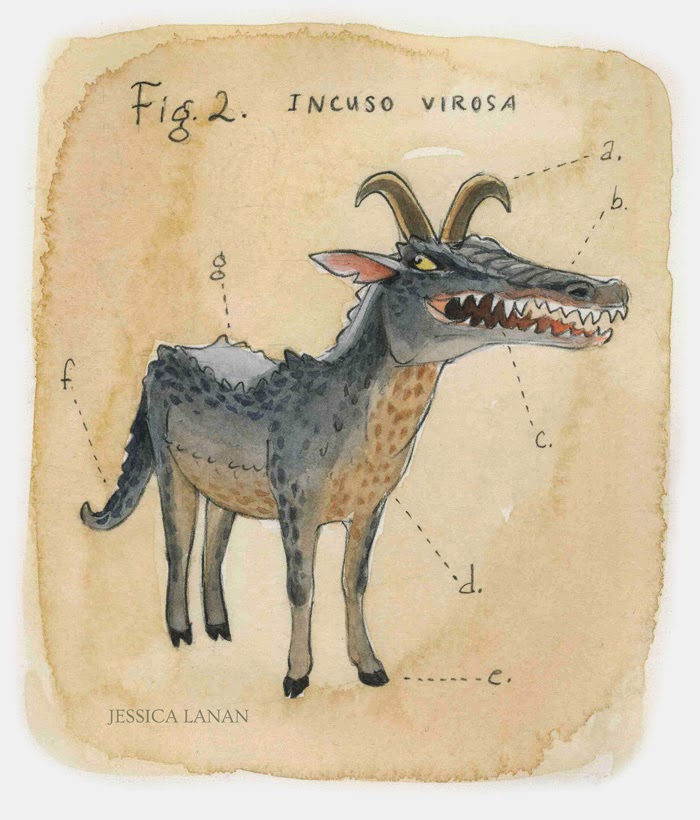
The Critic (Incuso Virosa)

Habitat: Your Mind
Diet: Negativity
Habits: Venomous. Often nocturnal, brings up worries at bedtime.

A wild Critic can lash out at your work (or life in general) with potent venom. “You aren’t talented enough,” the Critic will whisper in your ear. “Look at this other person’s work. It’s so much better.” The Critic will dredge up your mistakes and mockingly parade them before your eyes at your moment of greatest weakness.

As terrible as it sounds, A Critic can be helpful if it is trained to come out only when needed. The Critic is handy when deciding which thumbnail composition is better and why, or editing that manuscript in the second draft. But if it starts telling you that everything you make is garbage or that you’re not nearly as good as so-and-so, it’s time to go back in the kennel.

Tips for Coping with a Critic:
  •  Use a muzzle to keep it from biting
  • Feed it as little negativity as possible. 
  • Don’t let the Critic’s words become your own.
  • It’s okay to tell it to settle down. (Yes, out loud. Try it, I dare you!)
  • Critics shy away from laughter and fun. Remember fun?
  • Surround yourself with positive, encouraging people.

http://jessicalanan.com/

The Sloth (Choloepus Languidus)

Habitat: Your Mind
Diet: Inactivity
Habits: None

The sloth really wants you to succeed. It does. But it would rather not give up its Netflix marathons and surfing Facebook on its phone.

The Sloth is the creature that will tell you that your first thumbnail is good enough. Why bother trying other compositions? It will discourage you from taking those figure drawing classes you need, because that sounds like a lot of work after all. If you have a feeling that you need to work on your craft but you never seem to get around to doing it, you might be contending with one of these creatures.

Not to worry! Sloths can be trained. When properly employed, a Sloth can stop you from becoming a perfectionist, particularly on the projects that just aren’t worth the time. If you’re getting paid a pittance for an illustration, it probably isn't time to make the Mona Lisa. All it takes to train a Sloth is a little bit of priority shifting and the adoption of some new habits.

Tips for Training a Sloth:
  • Track your time and identify distractions.
  • If online distraction is a problem, you can use LeechBlock (Firefox) or StayFocused (Chrome) to limit the sites you can visit during specific times.
  • Put your phone out of reach and turn off notifications.
  • Force yourself to work on a project for just 20 minutes. Chances are good that the Sloth will slink away as you start to have fun with the project.
  • Work at a consistent time. Find a schedule that works for you.

In a Nutshell:


If you have a Critic, Ego or Sloth, don't beat yourself up over it. It's normal! Identify the species that is impeding your growth the most, and take a small step this week to help tackle it.

----

Jessica Lanan is a children's book writer and illustrator living in Boulder, Colorado. See more of her work at jessicalanan.com, on facebook or twitter.

Monday, December 23, 2013

For Those Who are Not Cinderella

If you’re an unpublished or aspiring author or illustrator, this post is written for you. If you have attended a few conferences or follow publishing blogs and the like, you may have come across at one point or another a story that goes about like this:

“Meet Jane Doe. Jane Doe was a totally unknown talent. Then one day, on a whim, she sent her manuscript/portfolio to [insert name of extremely famous and talented agent or editor.] Suddenly she became a whirlwind success! She was perfect! Her work was perfect! Everyone loved her! Her manuscript was immediately sold to the highest bidder and she subsequently won the Caldecott medal. And all that under the age of 30! Amazing!”

This story usually follows with something along these lines:

“Aspiring writers and illustrators will find her story very uplifting and inspirational."

Now, this is kind of the opposite of how I would expect that story to make people feel. If you ask me, I think aspiring writers and illustrators want to hear about how hard work and perseverance pays off, not about some insanely talented person's fairytale story. Usually the fairytale story makes you feel like you ought to just give up and go jump off a bridge.

However, people who want to devote their lives to making books for children (or at least the ones I know, with the conspicuous exception of myself) seem to be delightful human beings. If they feel envious they don’t show it. Before long they pick themselves up, look their friend in the eye and say, “I’m so happy for you! That’s really wonderful that you are an overnight sensation and have twelve book deals.” They smile and clap for their friends and go home and feel grateful that at least they can use their rejection letters to heat the house over the winter and save on utilities.


Feeling envious is normal. I’m convinced that most everyone does it, and if they claim that they don’t, it’s either because they’ve been very lucky and had a Cinderella-success-story of their own, or because they are lying. Those who can be extremely gracious and happy for the success of others are just more adept at letting go of the negative feelings. The important thing is is not to feel guilty for being jealous. Just accept that it’s a feeling that happens, and move on.

After all, these universal human feelings we struggle with are just the stuff of which great stories are made. Nobody wants to read about a perfect character who is gracious and charming and ideal in every way. It would be utterly bland. If you think about it, Cinderella is rather one-dimensional. What mistake did she ever make? How can a real person, full of faults, relate to her? Characters need imperfections, heroes need demons to conquer. Don’t hate yourself for your darker moments, just learn from them, and let them go so they don’t hold you back.

And just remember that if you ever end up on a stage giving a keynote address about your success, tell the audience what they need to hear: that you got to where you are by working hard, by not giving up, and by truly loving what you do.

They will love you for it.

----
Jessica Lanan is a children's book illustrator living in Boulder, Colorado. See more of her work at jessicalanan.com, on facebook or twitter.

Monday, October 28, 2013

Measuring Your Goals - by Maple Lam

Goal: Be very prepared for #LA14SCBWI

Goal established.  But what defines "very prepared"?  I deduce this to five categories.

Read.  Draw.  Write.  Promote.  Connect.

That's a lot of goals to hit!  The good news: Time is on our side.

Goal = (Baby Steps + Perseverance) / Time

To hit the baby steps milestones, here's a measurable plan.

1. READ

• Study stories, characters, pace, layouts.  Think about why each book works.
• Goal: 2 picture books a week.  In 9 months, that's 72 picture books.

Tips: Classic Picture Books, from GoodReads:  http://bit.ly/1incKqO
Tips: Modern Picture Books, from GoodReads:  http://bit.ly/1eY93Ip

2. DRAW

• Sketch daily.  Think about the element of storytelling.
• Goal: 2 portfolio pieces per month.  In 9 months, that's 18 pieces.  Select 10 to 12 for portfolio.

3. WRITE

• Get a cheap spiral notebook and write.  Jot down ideas.
• Goal: Write at least 20 minutes per day.

Tips: PiBoldMo is now open! Quick!  Challenge yourself:  http://bit.ly/H4BY1h

4. PROMOTE

• Goal: Send postcard to publishers every 3 months.
• Use proud illustration created on Goal #2 (DRAW).

5. CONNECT

• Follow industry news via Twitter.  Meet new friends via virtual and actual reality.

Tips: Fellow mentee Debbie Ridpath Ohi has a great Twitter List:  http://bit.ly/10KWYjJ

Write this down on a calendar.  Track these baby steps and stick with the plan.

And may the KidLit Force be with you.


Tuesday, July 23, 2013

Am I Growing?


Here are my thoughts on growth as an illustrator (nutshell version).

• Growth happens if you are working consistently. 

• Growth doesn’t always look like growth (that big pile of  sketches in the trash is growth).

• Expect growing pains (read: rejection).

• Growth comes in spurts. Or at least noticeable growth comes in spurts (book contract!). But you’re always growing, as long as you’re working, even a little.

Three things that are anti-growth:

1.  Comparison. Just want to make the distinction between learning from others and comparing yourself to others.    Learning = Good. Comparing = Despair

2. Comparing leads to should-ing on yourself. Don't do it... messy.

3. Comparing yourself to others.

Yes, I did list comparison 3 times. It makes you feel bad. I think it makes you feel bad even if you’re on a roll and on top of the world because you are focused outside of your business. Your business is being the wonderful, creative, growing being that you are, whether you are a wee one, a giant one, or somewhere in between.

Keep working, keep growing!

Tuesday, April 23, 2013

5 Tips For Children's Book Illustrators (and Writers!) On How To Keep From Getting In A Rut


No matter how experienced you are in the children's book publishing field, there's always room to grow. Here are a few ideas on how to keep from getting into a creative rut:

Keep learning.

If you get in the mindset that you know everything there is to know about the craft and business of children's book writing and illustration, you'll miss out on opportunities to widen your creative horizons as well as become a better writer/illustrator.

"I'm way to busy to learn anything new," you may be thinking, and may very well have a ton already on your plate: a day job, for instance, or children demanding your attention, impending deadlines, promotion and marketing efforts, and so on.

Try to set aside regular time, even if it's just an hour a week (or every two weeks, or every month) to purposely learn something new about the craft or business. Between those sessions, keep a list of any articles, websites, online tutorials, etc. that interest you.

Look for new ways to get inspired.

Some ideas:

- Attend SCBWI conferences and events.

- Surround yourself with creative people who inspire you.

- Browse blogs and social media feeds of people who inspire you.

- Take regular walks. Don't listen to music or audiobooks, but just let your thoughts wander. I find that whenever I'm getting frustrated or blocked during work, getting away from the Internet is sometimes a good thing.

- Go to the library or bookstore and browse picture books.

Try something different.

Experiment with art techniques different from your usual. Do you usually work with watercolor? Try acrylics. Is most of your art digital? Play around with some physical art materials. You don't need to spend a ton of money. Borrow crayons from your kids. Browse your local art store for sales.

Is your style cartoon-y? Try realistic. If realistic, try cartoon-y. Sure, your experimental drawings may suck, but you don't have to show anyone else.

Do you usually draw people? Try landscapes or architecture. Do you shy away from figure drawing? Force yourself to try it anyway, on a regular basis. You will get better over time.

Change up your work habits: when you work and how you work.

Never tried writing a picture book before? Start keeping an idea notebook. Collect story snippets. The more you write, the better you'll get.


Remember to play.

Don't get so bogged down in the stress of the business (trying to get published, angsting about reviews or sales, publishing politics, etc.) that you forget to play. Doodle for fun. Draw with your kids. If you don't have kids, draw with someone else's kids.

Write for fun. Keep a creative journal. Try Morning Pages.


BE BRAVE.

Fear of failure is one major reason that many children's book writers and illustrators tend to get into a rut. Another is complacency.

Be courageous. Yes, you may fail. I've failed more times than I can count. It can be embarrassing and disheartening at the time, but I've learned to give myself a day or less to wallow, then I move on.

What I've found: it's worth the risk.

So... what do YOU do to keep growing as a children's book illustrator and/or writer? Feel free to share below.


Debbie Ridpath Ohi illustrated I'M BORED, a picture book by Michael Ian Black and published by Simon & Schuster Books For Young Readers. She is currently working on two more books for Simon & Schuster as well as HarperCollins. Twitter: @inkyelbows.