

The Ego (Vanus Fragilis)
Habitat: Your mindDiet: Flattery and attention
Habits: Strictly solitary
The Ego is a sensitive soul. It craves reassurance and takes failure quite personally. Desperate to convince itself that it is valuable, the Ego and will avoid situations where failure might occur. "Don't enter the contest, don't send the manuscript!" the Ego will plead, because it's easier to say I didn't try than I didn't succeed.
Unfortunately for the Ego, failure is a necessary part of growth. We learn the most when we push ourselves out of our comfort zones and try new things. The best way to succeed is to increase our failure rate, and the best way to learn is to face our failures head on and look at what worked, what didn't, and why.
Tips for Tempering an Ego:
- Avoid overfeeding. Egos gorge themselves on attention.
- Cultivate gratitude.
- Remember: The Ego is not you—it just lives in your mind.
- Set up a nice little Ego-cage in the back of your mind where it can stay out of the way.
- Stay away from junk foods like flattery, which lead to a bloated and irritable Ego.
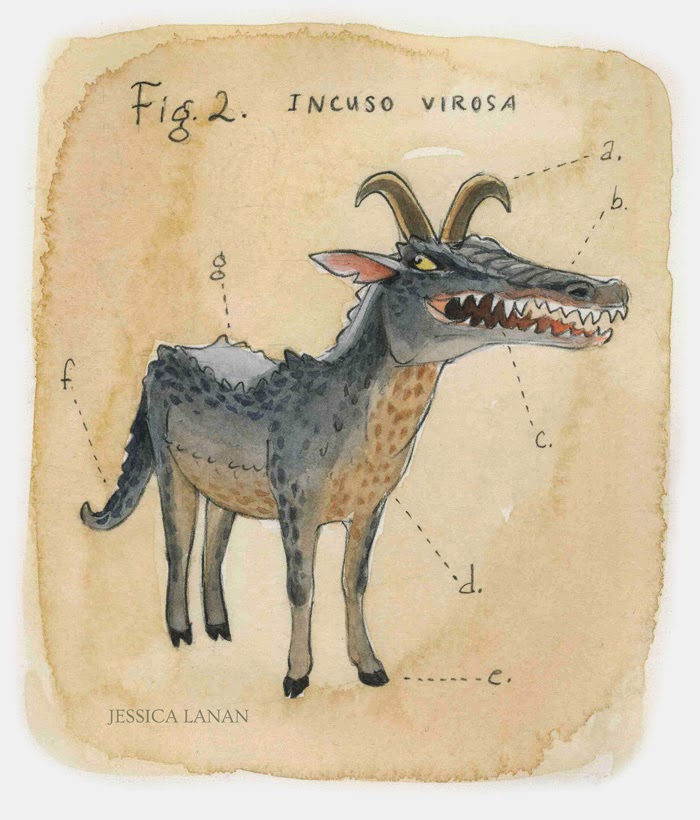
The Critic (Incuso Virosa)
Habitat: Your MindDiet: Negativity
Habits: Venomous. Often nocturnal, brings up worries at bedtime.
A wild Critic can lash out at your work (or life in general) with potent venom. “You aren’t talented enough,” the Critic will whisper in your ear. “Look at this other person’s work. It’s so much better.” The Critic will dredge up your mistakes and mockingly parade them before your eyes at your moment of greatest weakness.
As terrible as it sounds, A Critic can be helpful if it is trained to come out only when needed. The Critic is handy when deciding which thumbnail composition is better and why, or editing that manuscript in the second draft. But if it starts telling you that everything you make is garbage or that you’re not nearly as good as so-and-so, it’s time to go back in the kennel.
Tips for Coping with a Critic:
- Use a muzzle to keep it from biting
- Feed it as little negativity as possible.
- Don’t let the Critic’s words become your own.
- It’s okay to tell it to settle down. (Yes, out loud. Try it, I dare you!)
- Critics shy away from laughter and fun. Remember fun?
- Surround yourself with positive, encouraging people.

The Sloth (Choloepus Languidus)
Habitat: Your MindDiet: Inactivity
Habits: None
The sloth really wants you to succeed. It does. But it would rather not give up its Netflix marathons and surfing Facebook on its phone.
The Sloth is the creature that will tell you that your first thumbnail is good enough. Why bother trying other compositions? It will discourage you from taking those figure drawing classes you need, because that sounds like a lot of work after all. If you have a feeling that you need to work on your craft but you never seem to get around to doing it, you might be contending with one of these creatures.
Not to worry! Sloths can be trained. When properly employed, a Sloth can stop you from becoming a perfectionist, particularly on the projects that just aren’t worth the time. If you’re getting paid a pittance for an illustration, it probably isn't time to make the Mona Lisa. All it takes to train a Sloth is a little bit of priority shifting and the adoption of some new habits.
Tips for Training a Sloth:
- Track your time and identify distractions.
- If online distraction is a problem, you can use LeechBlock (Firefox) or StayFocused (Chrome) to limit the sites you can visit during specific times.
- Put your phone out of reach and turn off notifications.
- Force yourself to work on a project for just 20 minutes. Chances are good that the Sloth will slink away as you start to have fun with the project.
- Work at a consistent time. Find a schedule that works for you.
In a Nutshell:
If you have a Critic, Ego or Sloth, don't beat yourself up over it. It's normal! Identify the species that is impeding your growth the most, and take a small step this week to help tackle it.
----
Jessica Lanan is a children's book writer and illustrator living in Boulder, Colorado. See more of her work at jessicalanan.com, on facebook or twitter.


